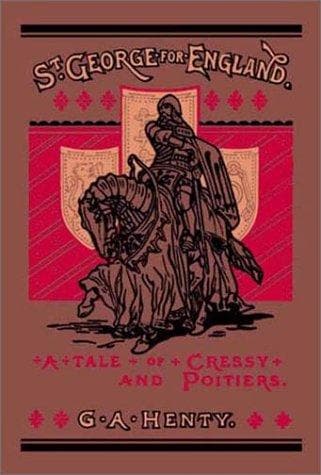
St. George for EnglandHenty, G. A. (George Alfred)
History
St. George for England
Henty, G. A. (George Alfred)
Great Britain -- History -- Edward III, 1327-1377 -- Fiction
Some months after his return to England the Black Prince asked his
father as a boon that the hand of his ward Edith Vernon should be
bestowed upon the prince's brave follower Sir Walter Somers, and as
Queen Philippa, in the name of the lady's mother, seconded the request,
the king at once acceded to it. Edith was now sixteen, an age at which,
in those days, a young lady was considered to be marriageable, and the
wedding took place with great pomp and ceremony at Westminster; the
king himself giving away the bride, and bestowing, as did the prince and
Queen Philippa, many costly presents upon the young couple. After taking
part in several of the tournaments, Walter went with his bride and Dame
Vernon down to their estates, and were received with great rejoicing
by the tenantry, the older of whom well remembered Walter's father and
mother, and were rejoiced at finding that they were again to become the
vassals of one of the old family. Dame Vernon was greatly loved by her
tenantry; but the latter had looked forward with some apprehension to
the marriage of the young heiress, as the character of the knight upon
whom the king might bestow her hand would greatly affect the happiness
and well being of his tenants.
Sir James Carnegie had not returned to England after the fall of Calais;
he perceived that he was in grave disfavour with the Black Prince,
and guessed, as was the case, that some suspicion had fallen on him
in reference to the attack upon Walter in the camp, and to the strange
attempt which had been made to destroy him by Sir Phillip Holbeaut. He
had, therefore, for a time taken service with the Count of Savoy, and
was away from England, to the satisfaction of Walter and Dame Vernon,
when the marriage took place; for he had given proofs of such a
malignity of disposition that both felt, that although his succession to
the estates was now hopelessly barred, yet that he might at any moment
attempt some desperate deed to satisfy his feeling of disappointment and
revenge.
Public-domain text, read in full here on John Shaqi.
Reviews
Reviews
No reviews yet
Be the first to share your thoughts on this work.
Elsewhere in the archive
Join the Discussion
Join the discussion
Sign in to leave a comment or review.
Sign InorCreate an account