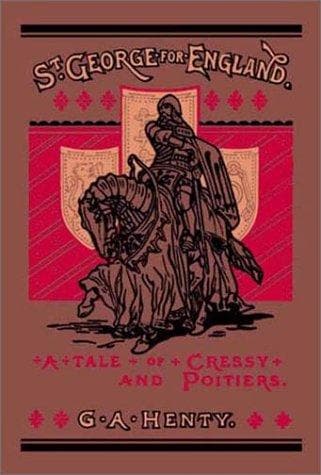
St. George for EnglandHenty, G. A. (George Alfred)
History
St. George for England
Henty, G. A. (George Alfred)
Great Britain -- History -- Edward III, 1327-1377 -- Fiction
In England the march of the pestilence westward was viewed with deep
apprehension, and the approaching danger was brought home to the people
by the death of the Princess Joan, the king's second daughter. She was
affianced to Peter, the heir to the throne of Spain; and the bride, who
had not yet accomplished her fourteenth year, was sent over to Bordeaux
with considerable train of attendants in order to be united there to
her promised husband. Scarcely had she reached Bordeaux when she was
attacked by the pestilence and died in a few hours. A few days later
the news spread through the country that the disease had appeared almost
simultaneously at several of the seaports in the south-west of England.
Thence with great rapidity it spread through the kingdom; proceeding
through Gloucestershire and Oxfordshire it broke out in London, and the
ravages were no less severe than they had been on the Continent, the
very lowest estimate being that two-thirds of the population were swept
away. Most of those attacked died within a few hours of the seizure. If
they survived for two days they generally rallied, but even then many
fell into a state of coma from which they never awoke.
No words can describe the terror and dismay caused by this the most
destructive plague of which there is any record in history. No remedies
were of the slightest avail against it; flight was impossible, for the
loneliest hamlets suffered as severely as crowded towns, and frequently
not a single survivor was left. Men met the pestilence in various moods:
the brave with fortitude, the pious with resignation, the cowardly and
turbulent with outbursts of despair and fury. Among the lower classes
the wildest rumours gained credence. Some assigned the pestilence to
witchcraft, others declared that the waters of the wells and streams had
been poisoned. Serious riots occurred in many places, and great numbers
of people fell victims to the fury of the mob under the suspicion of
being connected in some way with the ravages of the pestilence. The
Jews, ever the objects of popular hostility, engendered by ignorance
and superstition, were among the chief sufferers. Bands of marauders
wandered through the country plundering the houses left empty by the
death of all their occupants, and from end to end death and suffering
were universal.
Although all classes had suffered heavily the ravages of the disease
were, as is always the case, greater among the poor than among the rich,
the insanitary conditions of their life, and their coarser and commoner
food rendering them more liable to its influence; no rank, however, was
exempted, and no less than three Archbishops of Canterbury were carried
off in succession by the pestilence within a year of its appearance.
Public-domain text, read in full here on John Shaqi.
Reviews
Reviews
No reviews yet
Be the first to share your thoughts on this work.
Elsewhere in the archive
Join the Discussion
Join the discussion
Sign in to leave a comment or review.
Sign InorCreate an account