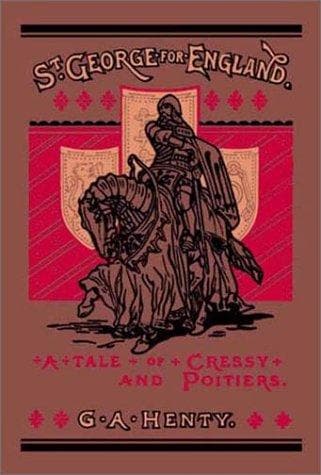
St. George for EnglandHenty, G. A. (George Alfred)
History
St. George for England
Henty, G. A. (George Alfred)
Great Britain -- History -- Edward III, 1327-1377 -- Fiction
“Forward, then, John Chandos,” replied the prince. “You shall not see me
tread one step back, but ever in advance. Bear on my banner. God and St.
George be with us!”
The horses of the English force were all held in readiness by their
attendants close in their rear. Every man sprang into his saddle, and
with levelled lances the army bore down the hill against the enemy,
while the Captal De Buch forced his way through the struggling ranks of
the French to join them.
To these two parties were opposed the whole of the German cavalry, the
division of the Dauphin, now thinned by flight, and a strong force
under the Constable de Brienne, Duke of Athens. The first charge of the
English was directed against the Germans, the remains of the marshal's
forces, and that commanded by the Constable. The two bodies of cavalry
met with a tremendous shock, raising their respective war-cries, “Denis
Mount Joye!” and “St. George Guyenne!” Lances were shivered, and horses
and men rolled over, but the German horse was borne down in every
direction by the charge of the English chivalry. The Counts of Nassau
and Saarbruck were taken, and the rest driven down the hill in utter
confusion. The division of the Duke of Orleans, a little further down
the hill to the right, were seized with a sudden panic, and 16,000
men-at-arms, together with their commander, fled without striking a
blow.
Having routed the French and German cavalry in advance, the English now
fell upon the Dauphin's division. This had been already confused by the
attacks of the Captal De Buch, and when its leaders beheld the complete
rout of the marshals and the Germans, and saw the victorious force
galloping down upon them, the responsibility attached to the charge of
the three young princes overcame their firmness. The Lords of Landas,
Vaudenay, and St. Venant, thinking the battle lost, hurried the princes
from the field, surrounded by eight hundred lances, determined to place
them at a secure distance, and then to return and fight beside the king.
The retreat of the princes at once disorganized the force, but though
many fled a number of the nobles remained scattered over the field
fighting in separate bodies with their own retainers gathered under
their banners. Gradually these fell back and took post on the left of
the French king's division. The Constable and the Duke of Bourbon with
a large body of knights and men-at-arms also opposed a firm front to
the advance of the English. The king saw with indignation one of his
divisions defeated and the other in coward flight, but his forces were
still vastly superior to those of the English, and ordering his men to
dismount, he prepared to receive their onset. The English now gathered
their forces which had been scattered in combat, and again advanced to
the fight. The archers as usual heralded this advance with showers of
arrows, which shook the ranks of the French and opened the way for the
cavalry.
Public-domain text, read in full here on John Shaqi.
Reviews
Reviews
No reviews yet
Be the first to share your thoughts on this work.
Elsewhere in the archive
Join the Discussion
Join the discussion
Sign in to leave a comment or review.
Sign InorCreate an account