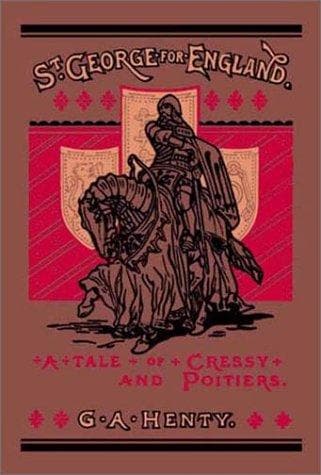
St. George for EnglandHenty, G. A. (George Alfred)
History
St. George for England
Henty, G. A. (George Alfred)
Great Britain -- History -- Edward III, 1327-1377 -- Fiction
Ralph arrived just as Walter was setting out. The latter presented
him to the knight, who spoke with praise of the gallantry which he had
displayed on the previous day, and then handed him over to John Mervaux,
with instructions to enroll him as a man-at-arms among his followers, to
inform him of his duties, and to place him with those who attended upon
the other esquires.
After seeing Ralph disposed of, Walter went across to the Earl of Talbot
and was again conducted to the presence of Dame Vernon.
“You have changed since we met last, young sir,” she said with a smile,
“though it is but a month since. Then you were a 'prentice boy, now you
are an esquire of Sir Walter Manny, and on the highway to distinction.
That you will win it I am well assured, since one who risked his life to
rescue a woman and child whose very names were unknown to him is sure to
turn out a noble and valiant knight. I little thought when my daughter
called you her knight, that in so short a time you might become an
aspirant to that honour. I hope that you do not look askance at us,
now that you know I am in possession of the lands of your parents. Such
changes of land, you know, often occur, but now I know who you are, I
would that the estates bestowed upon Sir Jasper had belonged to some
other than you; however, I trust that you will hold no grudge against
us, and that you may win as fair an estate by the strength of your arm
and the king's favour.”
“Assuredly I feel no grudge, madam,” Walter replied, “and since the
lands were forfeited, am pleased that of all people they should have
gone to one so kind and so fair as yourself.”
“What, learning to be a flatterer already!” Dame Vernon laughed. “You
are coming on fast, and I predict great things from you. And now, Edith,
lay aside that sampler you are pretending to be so busy upon and speak
to this knight of yours.”
Edith laid down her work and came forward. She was no longer the
dignified little queen of the tournament, but a laughing, bright-faced
girl.
“I don't see that you are changed,” she said, “except in your dress. You
speak softly and naturally, just as you used to do, and not a bit like
those little court fops, Uncle Talbot's pages. I am afraid you will
not want to be my knight any more, now that you are going to get great
honours at the war; for I heard my Uncle Talbot tell my lady mother that
he was sure you would gain great credit for yourself.”
“I shall be always your knight,” Walter said earnestly; “I told you I
should, and I never break my word. That is,” he went on, colouring, “if
Dame Vernon makes no objection, as she well might.”
“If I did not object before, Walter,” she said smiling, “why should I do
so now?”
“It is different, my lady; before, it was somewhat of a jest, a sort
of childish play on the part of Mistress Edith, though so far as I was
concerned it was no play, but sober earnest.
Public-domain text, read in full here on John Shaqi.
Reviews
Reviews
No reviews yet
Be the first to share your thoughts on this work.
Join the Discussion
Join the discussion
Sign in to leave a comment or review.
Sign InorCreate an account