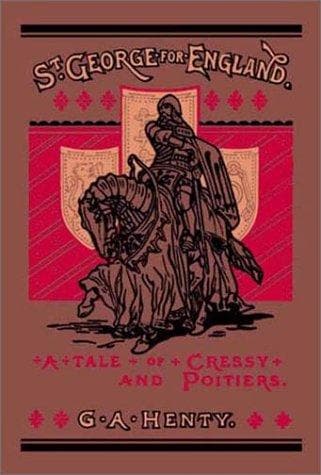
St. George for EnglandHenty, G. A. (George Alfred)
History
St. George for England
Henty, G. A. (George Alfred)
Great Britain -- History -- Edward III, 1327-1377 -- Fiction
All was now bustle in Hennebon. Sir John Powis took charge of a part of
the walls, and busied himself with his men in placing the machines in
position, and in preparing for defence. The countess, attired in armour,
rode through the streets haranguing the townspeople. She urged the men
to fight till the last, and bade the women and girls cut short their
dresses so that they could the better climb the steps to the top of the
walls, and that one and all should carry up stones, chalk, and baskets
of lime to be cast down upon the assailants. Animated by her words and
gestures, the townspeople set to work, and all vied with each other,
from the oldest to the youngest, in carrying up stores of missiles to
the walls. Never did Hennebon present such a scene of life and bustle.
It seemed like an ant-hill which a passer-by has disturbed.
Absorbed in their work, none had time to think of the dangers which
threatened them, and a stranger would rather have thought from their
cheerful and animated countenances that they were preparing for a
great fete than for a siege by an army to which the two chief towns in
Brittany had succumbed.
Ere long the French army was seen approaching. The soldiers, who had
been labouring with the rest, buckled on their armour. The citizens
gathered on the walls to hurl down the piles of stones which had been
collected, and all prepared for the assault.
“Sir John Powis,” the countess said, “I pray you to grant me one of your
esquires, who may attend me while I ride about, and may bear my messages
for me. He will not be idle, nor will he escape his share of the
dangers; for, believe me, I do not intend to hide myself while you and
your brave soldiers are fighting for me.
“Willingly, lady,” Sir John answered. “Here is Walter Somers, the son of
a good knight, and himself brave and prudent beyond his years; he will,
I am sure, gladly devote himself to your service.”
The French, encouraged by their successes, thought that it would be a
comparatively easy task to capture so small a place as Hennebon, and as
soon as their camp was pitched they moved forward to the attack.
“Come with me, Master Somers,” the countess said. “I will mount to one
of the watch-towers, where we may see all that passes.”
Walter followed her, and marvelled to see the lightness and agility with
which the heroic countess, although clad in armour, mounted the rickety
ladders to the summit of the watch-tower. The French bowmen opened
a heavy fire upon the walls, which was answered by the shafts of the
little party of English bowmen. These did much execution, for the
English archers shot far harder and straighter than those of France,
and it was only the best armour which could keep out their cloth-yard
shafts. So small a body, however, could not check the advance of so
large a force, and the French swarmed up to the very foot of the walls.
Public-domain text, read in full here on John Shaqi.
Reviews
Reviews
No reviews yet
Be the first to share your thoughts on this work.
Elsewhere in the archive
Join the Discussion
Join the discussion
Sign in to leave a comment or review.
Sign InorCreate an account