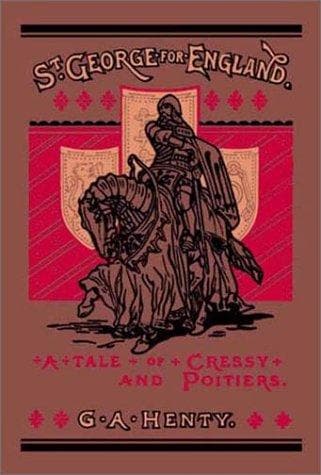
St. George for EnglandHenty, G. A. (George Alfred)
History
St. George for England
Henty, G. A. (George Alfred)
Great Britain -- History -- Edward III, 1327-1377 -- Fiction
Accordingly, on the fifth day after leaving the town, the countess
prepared to return. Except Walter, none were informed of her intention,
as she feared that news might be taken to the French camp by friends of
Charles of Blois; but as soon as it was nightfall, and the gates were
shut, the trumpet sounded to horse. In a few minutes the troop assembled
in the market-place, and the countess, accompanied by Walter, placing
herself at their head, rode out from the town. The strictest silence was
observed. On nearing the town all were directed to dismount, to tear
up the horse-cloths, and to muffle the feet of their horses. Then the
journey was resumed, and so careless was the watch kept by the French
that they passed through the sentries unobserved, and reached in
safety the gate from which they had issued. As they neared it they were
challenged from the walls, and a shout of joy was heard when Walter
replied that the countess herself was present. The gates were opened
and the party entered. The news of their return rapidly ran through the
town, and the inhabitants, hastily attiring themselves, ran into the
streets, filled with joy. Much depression had been felt during her
absence, and few had entertained hopes that she would be able to
re-enter the town. She had brought with her from Auray two hundred men,
in addition to the party that had sallied out.
CHAPTER IX: THE SIEGE OF HENNEBON
The besiegers of Hennebon were greatly discouraged at the success of the
enterprise of the countess. They had already attempted several desperate
assaults, but had each time been repulsed with very heavy loss. They
now sent to Rennes for twelve of the immense machines used in battering
walls, which had been left behind there on a false report of the
weakness of Hennebon. Pending the arrival of these, Charles of Blois,
with one division of the army, marched away to attack Auray, leaving Don
Louis to carry on the siege with a force considered amply sufficient to
compel its surrender after the arrival of the battering machines.
In a few days these arrived and were speedily set to work, and immense
masses of stone were hurled at the walls.
Walter continued to act as the countess's especial squire. She had
informed Sir William Caddoudal and Sir John Powis that it was at his
suggestion that she had made the sudden attack upon the French camp, and
he had gained great credit thereby.
Public-domain text, read in full here on John Shaqi.
Reviews
Reviews
No reviews yet
Be the first to share your thoughts on this work.
Elsewhere in the archive
Join the Discussion
Join the discussion
Sign in to leave a comment or review.
Sign InorCreate an account