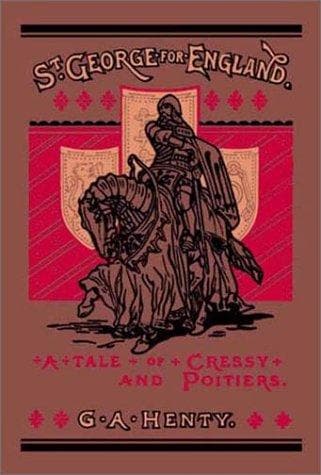
St. George for EnglandHenty, G. A. (George Alfred)
History
St. George for England
Henty, G. A. (George Alfred)
Great Britain -- History -- Edward III, 1327-1377 -- Fiction
At nightfall the assailants drew off to their camp, and Oliver de
Clisson, who commanded the town, suffered his weary troops to quit the
walls and to seek for refreshment and repose. The assailants, however,
did not disarm, but after a sufficient time had elapsed to allow the
garrison to lay aside their armour two strong parties attacked the
principal gates of the town, while Sir Walter Manny and the Earl of
Oxford moved round to the opposite side with ladders for an escalade.
The plan was successful. The garrison, snatching up their arms, hurried
to repel their attack upon the gates, every man hastening in that
direction. Sir Walter Manny with his party were therefore enabled to
mount the walls unobserved and make their way into the town; here they
fell upon the defenders in the rear, and the sudden onslaught spread
confusion and terror among them. The parties at the gates forced their
way in and joined their friends, and the whole of the garrison were
killed or taken prisoners, save a few, including Oliver Clisson, who
made their escape by sally-ports. Robert of Artois, with the Earl
of Stafford, was left with a garrison to hold the town. The Earl of
Salisbury, with four thousand men, proceeded to lay siege to Rennes, and
Sir Walter Manny hastened back to Hennebon.
Some of Sir Walter's men formed part of the garrison of Vannes, and
among these was Sir John Powis with a hundred men-at-arms.
The knight had been so pleased with Walter's coolness and courage at the
siege at Hennebon that he requested Sir Walter to leave him with him at
Vannes. “It is possible,” he said to Walter, “that we may have fighting
here. Methinks that Sir Walter would have done better to leave
a stronger force. The town is a large one, and the inhabitants
ill-disposed towards us. Oliver Clisson and the French nobles will feel
their honour wounded at the way in which we outwitted them, and will
likely enough make an effort to regain the town. However, Rennes and
Hennebon are not far away, and we may look for speedy aid from the Earl
of Salisbury and Sir Walter should occasion arise.”
Sir John's previsions were speedily verified. Oliver Clisson and his
friends were determined to wipe out their defeat, and scattered through
the country raising volunteers from among the soldiery in all the
neighbouring towns and castles, and a month after Vannes was taken they
suddenly appeared before the town with an army of 12,000 men, commanded
by Beaumanoir, marshal of Bretagne for Charles of Blois. The same
reasons which had induced the Earl of Northampton to decide upon a
speedy assault instead of the slow process of breaching the walls,
actuated the French in pursuing the same course, and, divided into a
number of storming parties, the army advanced at once to the assault on
the walls. The little garrison prepared for the defence.
Public-domain text, read in full here on John Shaqi.
Reviews
Reviews
No reviews yet
Be the first to share your thoughts on this work.
Elsewhere in the archive
Join the Discussion
Join the discussion
Sign in to leave a comment or review.
Sign InorCreate an account