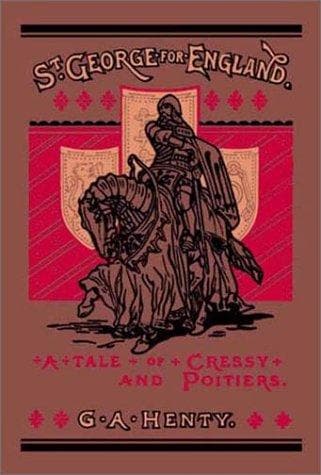
St. George for EnglandHenty, G. A. (George Alfred)
History
St. George for England
Henty, G. A. (George Alfred)
Great Britain -- History -- Edward III, 1327-1377 -- Fiction
Soon after Walter's return from France Dame Vernon returned to her
country estate, and a year passed before he again saw her. During this
time the truce which had been established between England and France had
remained unbroken. It was certain, however, that ere long the two powers
would again come to blows. The King of England had honourably observed
the terms of the treaty. Upon his return home he had entirely disbanded
his army and had devoted his whole attention to increasing the trade and
prosperity of the country. The measures which he took to do this were
not always popular with the people of England, for seeing how greatly
they excelled the English manufacturers Edward encouraged large numbers
of Flemings and other foreign workmen to settle in London, and gave
them many privileges to induce them to do so; this the populace strongly
resented. There was a strong ill feeling against the Flemings and
serious popular riots took place, for the English traders and workmen
considered that these foreigners were taking the bread from their
mouths. The king, however, was wiser than his people, he saw that
although the English weavers were able to produce coarse cloths, yet
that all of the finer sort had to be imported from the Continent. He
deemed that in time the Flemings would teach their art to his subjects,
and that England would come to vie with the Low Countries in the quality
of her produce. Such was indeed afterwards the case, and England gained
greatly by the importation of the industrious Flemings, just as she
afterwards profited from the expulsion from France of tens of thousands
of Protestant workmen who brought here many of the manufactures of which
France had before the monopoly. The relations between England and the
Flemings were at this time very close, for the latter regarded England
as her protector against the ambition of the King of France.
But while King Edward had laid aside all thought of war, such was not
the case with Phillip of Valois. He had retired after the signature
of the treaty full of rage and humiliation; for hitherto in all their
struggles his English rival had had the better of him, and against
vastly superior forces had foiled all his efforts and had gained alike
glory and military advantage. King Edward had hardly set sail when
Phillip began to break the terms of truce by inciting the adherents
of Charles of Blois to attack those of De Montford, and by rendering
assistance to them with money and men. He also left no means untried
to detach Flanders from its alliance with England. Several castles and
towns in Brittany were wrested from the partisans of De Montford, and
King Edward, after many remonstrances at the breaches of the conditions
of the truce, began again to make preparations for taking the field.
Several brilliant tournaments were held and every means were taken to
stir up the warlike spirit of the people.
Public-domain text, read in full here on John Shaqi.
Reviews
Reviews
No reviews yet
Be the first to share your thoughts on this work.
Elsewhere in the archive
Join the Discussion
Join the discussion
Sign in to leave a comment or review.
Sign InorCreate an account