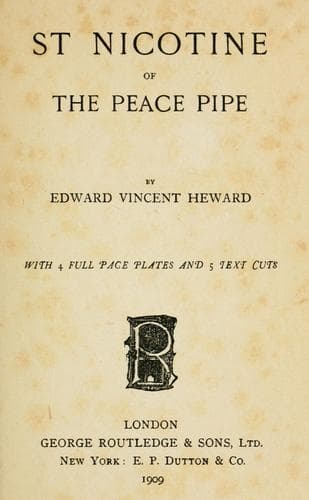
St Nicotine of the Peace PipeHeward, Edward Vincent
History
St Nicotine of the Peace Pipe
Heward, Edward Vincent
Smoking; Tobacco
is a dispenser of other inestimable blessings. As a healer of many
maladies—cutaneous affections, some forms of eye disease, and other like
disturbers of a tranquil life—he believes in her implicitly, and lotions
made of the juice extracted from the leaves of the plant are in almost
daily use among the poorer classes.
Young Japan having entered with a light heart and buoyant into the
stream of European life no longer cares for the old ways of his fathers,
and finds his chosen smoke in the new paper cigarette fashioned in the
Western world. Of these he partakes so liberally that many millions
are imported every year, the total value of which, according to the
Consular Report, comes to about £40,000. To such proportions has the
tobacco industry grown that in Osaka (the Manchester of Japan) no fewer
than forty factories provide remunerative employment for thousands of
work-people—chiefly women and girls. In 1895 Japan exported close upon
three million pounds weight of tobacco, the estimated value of which was
£23,466. Under the influence of an overmastering passion to mould their
institutions on the model of those of Europe, the Government have thought
well to lay hands upon the tobacco industry; henceforward it is to be a
Government monopoly. Referring to the _Japanese Budget_ of 1897-8, Sir
Ernest Satow, in the Diplomatic and Consular Report on Trade and Finance
for the fiscal year 1897-8, discusses the question. The Bill was passed
in the session of 1896, and the monopoly is to come into force at the
beginning of 1898. The principle of the scheme is, that tobacco grown
in Japan shall be delivered in the leaf to the Government at a fixed
rate. The Government will then sell it to the manufacturers at rates
which will ensure substantial relief to the depleted exchequer, to the
extent, possibly, after all expenses of collection, etc. are met, of
about half a million sterling. The annual yield of the tobacco fields
of Japan is estimated at 90,000,000 lbs., its market value of £90,000,
and the gross revenue therefrom at £1,000,000. Here Sir Ernest Satow’s
incisive criticism comes into play. He shows that to realize this sum a
tax of over 100 per cent. must be levied, and that this would bring up
the price to the consumer to double what it is now. He points out that
tobacco leaf can be imported into Japan at 10c. per lb., add to this
the import duty, namely 35 per cent., and the result will be that the
Government will try to sell its tobacco at 21⅑c. and this, too, in face
of the fact that imported tobacco can be sold for 13.5c. per lb. There
is a further important consideration telling against the Government
scheme, namely: that as the tobacco intended for exportation does not
come under the monopoly the producer can send his unmanufactured leaf out
of the country, have it prepared for use and brought in again ready for
the retail dealer, and still compete successfully with the Government.
Public-domain text, read in full here on John Shaqi.
Reviews
Reviews
No reviews yet
Be the first to share your thoughts on this work.
Elsewhere in the archive
Join the Discussion
Join the discussion
Sign in to leave a comment or review.
Sign InorCreate an account