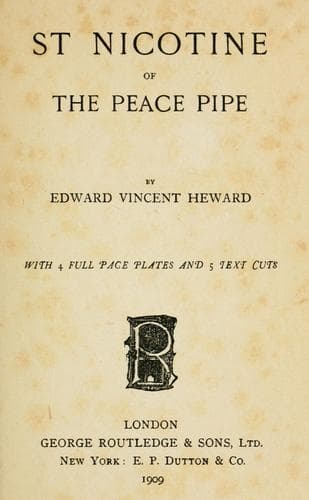
St Nicotine of the Peace PipeHeward, Edward Vincent
History
St Nicotine of the Peace Pipe
Heward, Edward Vincent
Smoking; Tobacco
There is a passage in the _Counterblaste_ which seems to point directly
to Raleigh; it runs as follows: ‘Now the corrupt baseness of the use
of this tobacco doeth very well agree with the foolish and groundless
first entry thereof into this kingdom. It is not so long since the first
entry of this abuse amongst us here, as this present age can very well
remember both the first author and the form of the first introduction
of it amongst us. It was neither brought in by king, great conqueror,
nor learned doctor of physick. With the report of a great discovery
for a conquest, some two or three savage men were brought in, together
with this savage custom. But the pity is, the poor, wild, barbarous
men died; but that vile, barbarous custom is yet alive, yea, in fresh
vigour, so as it seems a miracle to me how a custom springing from so
vile a ground, and brought in by a father so generally hated, should be
welcomed on so slender a warrant.’ The mention of ‘two or three savage
men’ clearly indicates the return of Raleigh’s first expedition in 1584,
when Captain Amadas and Barlowe brought with them two American Indians,
whose appearance in the streets was regarded as one of the sights of
London. James’s inveterate enmity towards Raleigh would seem to have
originated at their first encounter at Burghly, in Lincolnshire, when the
King faltered out: ‘On my soul, mon, I hae heard but rawley o’ thee,’
a clumsy attempt at a pun. Doubtless Raleigh’s noble bearing and rich
attire would touch James’s inordinate self-importance, which seems to
have at all times blinded him to a proper sense of decency, according
to Sir Anthony Weldon’s simple, graphic presentation of him. On the
King boasting that, had the English crown not been offered to him, his
Scotch army would have taken it for him, Raleigh, indignant, made the
injudicious remark: ‘Would God that had been put to the test.’ ‘Why?’
asked James. Raleigh recovering himself replied, ‘Your Majesty would then
have known your friends from your foes.’ Aubrey says that James never
forgave this speech. One by one, Raleigh was stripped of all his offices;
and before the end of the first year of James’s reign (November 4, 1603)
he was lodged in the Tower on a false charge of treason, and after
fifteen years’ imprisonment was judicially murdered by order of the King.
Speaking of this event, Sir Anthony Weldom remarks, ‘How this kingdom
was gulled in the supposed treason of Sir Walter Rawley and others who
suffered as traytors, whereas to this day it could never be knowne that
there ever was such treason, but a mere trick of State to remove some
blotches out of the way.’ When Raleigh’s fate drew nigh, ‘he took a pipe
of tobacco a little before he went to the scaffolde,’ says Aubrey, ‘which
some female persons were scandalised at; but I think ’twas well and
properly donne to settle his spirits.’
Public-domain text, read in full here on John Shaqi.
Reviews
Reviews
No reviews yet
Be the first to share your thoughts on this work.
Elsewhere in the archive
Join the Discussion
Join the discussion
Sign in to leave a comment or review.
Sign InorCreate an account