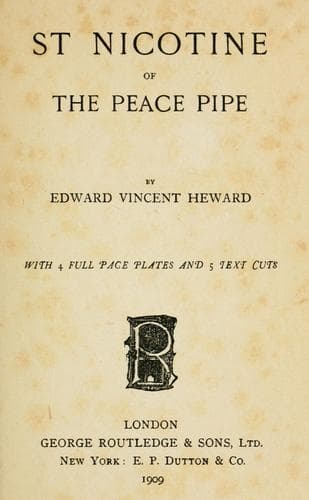
St Nicotine of the Peace PipeHeward, Edward Vincent
History
St Nicotine of the Peace Pipe
Heward, Edward Vincent
Smoking; Tobacco
But King James had not yet done with tobacco. A monarch of his remarkable
idiosyncrasy, as displayed in his creation of a new and lucrative
business for the sale of distinguished titles and high offices of State,
where he himself possessed the sole monopoly, would naturally see his
way to a further stroke of ‘good business’ in the tobacco market.
Accordingly, we are not surprised to learn that, viewing with a jealous
eye the flourishing state of the new industry, the idea occurred to him
that the State coffers might be replenished by taking a still deeper
interest in the weed. Hence the issue of a royal proclamation to his
loving subjects that they were forbidden to deal in tobacco unless they
purchased Royal Letters Patent granting them a license to do so. These
could only be procured, on payment of a yearly sum, from the persons who
farmed from the King the right to enforce and collect the tax. In the
_Stafford Letters_, compiled by Gerrard, relating to the collection of
the new tax, it is stated that ‘some towns have yielded twenty marks,
£10, £5, £6, fine and rent; none goes under. I hear that Plymouth hath
yielded £100 and as much yearly rent.… The tobacco licences go on apace;
they yield a good fine, and a constant yearly rent.…’ In some instances
a life-lease to deal in tobacco was granted on payment of a lump sum. As
to the King’s method of dealing with State affairs of the kind, let Sir
Anthony Weldon speak from personal knowledge. He says of the King that
‘he was so crafty and cunning in petty things, as the circumventing any
great man. He had a trick of cousen (cozen) himself with bargains under
hand, by taking £1,000 or £10,000 as a bribe, when (at the same time)
his Counsel was treating with his Customers to raise them to so much
more yearly; this went into his Privy purse; wherein he thought he had
over-reached the Lords, but consented himself; but would as easily break
the bargain upon the next offer, saying he was mistaken and deceived,
and therefore no reason he should keep the bargain. This was often the
case with the Farmers of the Customs.’
There is a document in the State Archives which throws a curious
side-light on the King’s ideas of statecraft. The settlers in Guiana had
become tobacco-planters, and required a trade-charter with this country.
A charter was granted them, in which a clause was inserted to the effect
that one-tenth of the tobacco grown there should go to the King. Thus, in
a roundabout way, the King became a tobacco merchant.
Public-domain text, read in full here on John Shaqi.
Reviews
Reviews
No reviews yet
Be the first to share your thoughts on this work.
Elsewhere in the archive
Join the Discussion
Join the discussion
Sign in to leave a comment or review.
Sign InorCreate an account