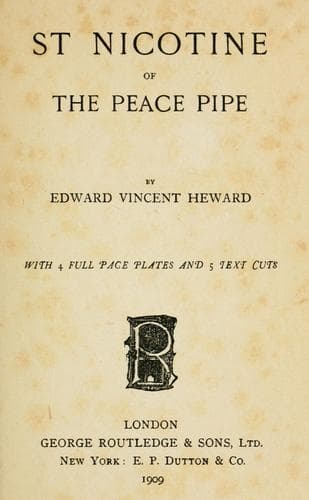
St Nicotine of the Peace PipeHeward, Edward Vincent
History
St Nicotine of the Peace Pipe
Heward, Edward Vincent
Smoking; Tobacco
to their homes, but to privately and secretly destroy all the materials,
machines and instruments of production.
It is not a little amusing to learn how energetically the envoy carried
out the order of destruction. He relates at considerable length in his
home despatch how he and his secretary (a private secretary undoubtedly)
spent a _night_ in breaking up all the machinery and laying waste the
material; how he afterwards explained to the Tsar that the object of his
zealous operations in smashing up the plant was to save his Majesty’s
subjects from a burdensome monopoly and thus, really, to encourage and
enhance the tobacco trade in Russia. Remembering that the Tsar was Peter
the Great, we are not surprised to learn that our excellent envoy was
listened to with impatience.
CHAPTER IX.
SOCIAL GOSSIP ABOUT THE WEED.
Why should we so much despise
So good and wholesome an exercise
As early and late, to meditate?
Thus think, and drink tobacco.
G. W.
Ancient and delightful George Wither, while suffering for conscience’
sake imprisonment in the Marshalsea, found a never-failing comfort in his
beloved Indian weed. Its soothing vapours moved him to meditation; the
earthen pipe, the burning weed, the vanishing fumes, and the ashes left
behind, were to him emblems of the transitory nature of man’s earthly
career. Musing thus, he poured forth his thoughts in a poem which has
taken a firmer hold on the popular taste than any other of the countless
songs composed on the subject of tobacco. It has undergone numerous
alterations, but in every instance for the worse. In a mutilated form,
and with a second part added, it is found among the ‘Gospel Sonnets’
of the Rev. Ralph Erskine, of the Scottish Church. It is the ‘Smoking
Spiritualized’ which is still in print among the ballad-vendors of the
east end of London. It reappeared with variations in Mr. J. H. Dixon’s
‘Songs and Ballads of the Peasantry of England’; and again in the Rev.
James Plumptre’s ‘Tobacco is an Indian weed.’ So popular had the song
become that Dr. Hague, in 1805, set the words to music, and Mr. Samuel
Wesley, at a later date, adapted them to a tune said to be still in
vogue. Yet, out of the multitude of admirers who so readily adopted and
adapted Wither’s song, no one seems to have cared to acknowledge the
source of his inspiration. But for the diligent research of Mr. Payne
Collier, the student might have remained forever in ignorance of its true
parentage. Turning to Mr. Chappell’s ‘Popular Music of the Olden Time’
we come upon the following passage relating to this song:—‘The earliest
copy’ says Mr. Chappell, ‘I have seen is in a manuscript volume of poetry
transcribed during James’s reign and which was kindly lent to me by Mr.
Payne Collier. It there bears the initials of G[eorge] W[ither] a very
likely person to have written such a song. A courtier poet would not have
Public-domain text, read in full here on John Shaqi.
Reviews
Reviews
No reviews yet
Be the first to share your thoughts on this work.
Elsewhere in the archive
Join the Discussion
Join the discussion
Sign in to leave a comment or review.
Sign InorCreate an account