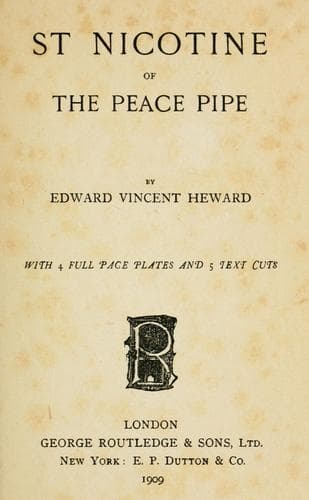
St Nicotine of the Peace PipeHeward, Edward Vincent
History
St Nicotine of the Peace Pipe
Heward, Edward Vincent
Smoking; Tobacco
The various kinds of tobacco and the sources of supply are exceedingly
numerous. Every country, indeed, has attempted to cultivate the plant
and reap a share of the rich harvest it yields to the planter and to
the government. Special qualities, as of wine, belong to particular
localities, outside of which they cannot, by any skill or coaxing, be
raised. A puzzling example of nature’s fickle moods in the production
of the plant was found a few years ago in Sumatra, where on one side of
a field a leaf was yielded rich in all the qualities delicate smokers
desire, and on the other side, but a few yards off, a very inferior plant
grew. So far as an experienced cultivator could see the conditions were
alike: seed, soil, and culture and aspect were the same. And as is the
case with wines, the crops vary in richness and delicacy of flavour with
the seasons of their growth, so that in some years the yield is of much
greater value than in other years, though tobacco of the ‘Comet year’ has
not yet been proclaimed in commerce. The natural properties of certain
classes of tobacco render them especially suited for cigar-making;
others are best fitted for smoking in pipes, and there are numerous
qualities which are valuable for snuff-making. National tastes and
habits again frequently determine the destination of the weed. Thus,
heavy, full-flavoured cigars and strong pipe-tobacco are in favour in
North America, while in Europe, lighter, and more brisk-burning are
sought after. By far the most valuable tobaccos in the world are grown
in Cuba, and the richest of all is found in the gardens of Vuelta Abajo
in the north-west district; after which come the products of Partidas
and Vuelta Arriba. A large portion of the tobacco is made into cigars
in the island, but considerable quantities are exported to Europe for
mixing with commoner kinds to give Havana flavour to home-made cigars.
Cuba, though no longer the emporium of the tobacco world, still ranks
first among the favoured places of the earth for the finest growths of
the plant. In culture and make-up, in classification and nomenclature
of the different kinds of tobacco, the Queen of the Antilles is, as she
has always been, a model to the tobacco-producing world. Foremost among
her thousand factories stands the Royal and Imperial of La Hondradez.
It occupies a whole square, and is looked upon as one of the sights of
Havana. Before the McKinley tariff cast gloom over the Home industry,
this factory, alone, produced nearly two millions of cigarettes daily;
and the total number of cigars exported in 1889 was about two hundred
and fifty millions. Under the McKinley tariff the exportation of cigars
declined rapidly to about one half this number, with the consequent
loss of employment for factory operatives. On the other hand, however,
the exports of unmanufactured leaf rose in like proportion. The highest
class of Cuban cigars called ‘Vegueras,’ are prepared from the finest
Public-domain text, read in full here on John Shaqi.
Reviews
Reviews
No reviews yet
Be the first to share your thoughts on this work.
Elsewhere in the archive
Join the Discussion
Join the discussion
Sign in to leave a comment or review.
Sign InorCreate an account