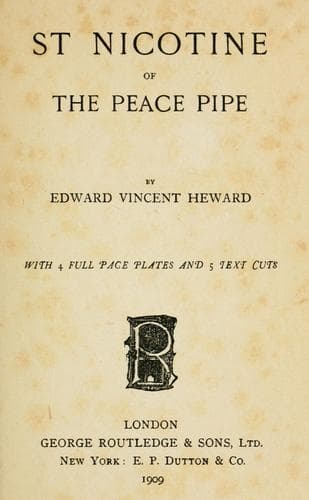
St Nicotine of the Peace PipeHeward, Edward Vincent
History
St Nicotine of the Peace Pipe
Heward, Edward Vincent
Smoking; Tobacco
In looking over the various sorts of tobacco presented by the
tobacconists to the consumer we need not touch upon the delicate ground
of ‘vested interests.’ It will suffice our present purpose if we notice
merely that from the same hogshead a selection and classification is made
of the leaves according to the shade of colour, and that the lightest
coloured (the mild) ones are reserved for less liquoring and pressure
than is given to the darker coloured leaves. ‘Returns,’ for example, is
the product of the lightest leaves and less pressure. A large quantity
of water used in the process of liquoring has the effect of darkening
the colour and giving strength to the flavour of the tobacco. By extreme
watering and pressure is produced the kind so dear to the sailor called
‘pigtail,’ as well as the less pungent ‘sag,’ of which there are two
sorts, fine and common, the difference consisting of the fineness or
coarseness of the shreds into which the leaf is cut. These and many
other odd circumstances in the manufacture give the different degrees of
strength and flavour sought for by the varying tastes of smokers.
In the opinion of experienced smokers a new cigar is never good; like
wine, the weed requires age to bring it to perfection—the highly prized
excellences, a mild, cool aromatic smoke. Curiously enough, the marks
of a mite on the outer leaf are the true signs of matured years, when
the cigar is fitted to regale the jaded senses and dispose the most
obdurate of men to relax into sociality. But these seductive touches by
an invisible hand are well known to the manufacturer, and are sometimes
artificially produced by means of acid. Fancy or experience has suggested
different kinds of cigars for different seasons of the year, or climates.
The Havana is thought by connoisseurs to be the most agreeable for
summer or hot countries, and for winter or cold climates a principe is
preferred; while the thoughtful and imaginative are assured that there
is no leaf like the Manila. And as regards the Manila there is something
to warrant the suggestion. The tobacco of Luzon when mixed with that of
the Gapanian plantation is considered to make the very perfection of all
cheroots. Its excellences consist in a delicate flavour combined with
a slightly soporific quality: properties which render it so pleasantly
alluring to the imaginative, and which to some smokers suggest the use of
opium in its preparation; this, however, is not so; to the climate and
soil alone are due the grateful pleasures of this most solacing smoke.
There are three different and distinct growths of the tobacco-plant in
the Philippines. A strong, aromatic tobacco is grown in great abundance
in the province of Cagayan in the island of Luzon, and the district of
Gapan in Pampanga produces a leaf of a very mild and agreeable flavour,
while from Bisayas a tobacco much inferior to either is raised. In the
manufacture of the poorer kind it is a common practise to use a leaf
Public-domain text, read in full here on John Shaqi.
Reviews
Reviews
No reviews yet
Be the first to share your thoughts on this work.
Elsewhere in the archive
Join the Discussion
Join the discussion
Sign in to leave a comment or review.
Sign InorCreate an account