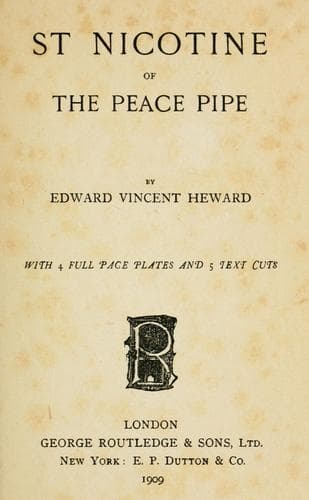
St Nicotine of the Peace PipeHeward, Edward Vincent
History
St Nicotine of the Peace Pipe
Heward, Edward Vincent
Smoking; Tobacco
A distinguished physician and man of science, Sir B. W. Richardson, has
tested the tobacco leaf and all its component parts with a thoroughness
which puts to flight all doubts as to what it is ‘men put into their
mouths to take away their brains.’ The chief results of his experiments
may be briefly summarised. Although evident differences prevail in
respect to the products arising from different cigars, different tobacco,
and different pipes, there are certain substances common to all varieties
of tobacco-smoke. Firstly, in all tobacco-smoke there is a certain amount
of watery vapour which can be separated from it. Secondly, a small
quantity of free carbon is always present; it is to the presence of this
constituent that the blue colour of tobacco is due. It is this carbon
which in confirmed and inveterate smokers settles on the back part of the
throat and on the lining of the membrane of the bronchial tubes, creating
often a copious secretion which it discolours. Thirdly, the presence of
ammonia can be detected in small quantity, and this gives to the smoke
an alkaline reaction that bites the tongue after long smoking; it is
the ammonia that makes the tonsils and throat of the smoker so dry, and
induces him to quaff as he smokes, and that partly excites the salivary
glands to secrete so freely. This element also exerts an influence on the
blood. Fourthly, the test of lime-water applied to the leaf shows the
presence of carbonic acid. In the smoke the quantity differs considerably
in different kinds of tobacco; to the action of this constituent Sir B.
W. Richardson traces the sleepiness, lassitude, and headache which follow
upon prolonged indulgence of the pipe. Fifthly, the smoke of tobacco
yields a product having an oily appearance and possessing poisonous
properties; this is commonly known as nicotine, or oil of tobacco, which
on further analysis is found to contain three substances, namely, a fluid
alkaloid (the nicotine of the chemist), a volatile substance, having an
empyreumatic odour, and an extract of a dark resinous character, of a
bitter taste. From this comes the smell peculiar to stale tobacco which
hangs so long about the clothing of habitual smokers—if the smell be
from good Eastern-grown tobacco many persons think it wholesome. It is
nevertheless this extract which creates in those unaccustomed to its use
a feeling akin to sea-sickness. Hence it appears that the more common
effects are due to the carbonic acid and ammonia liberated in the process
of smoking, while the rarer and more severe symptoms are due to the
nicotine, the empyreumatic substance, and the resin.
Public-domain text, read in full here on John Shaqi.
Reviews
Reviews
No reviews yet
Be the first to share your thoughts on this work.
Join the Discussion
Join the discussion
Sign in to leave a comment or review.
Sign InorCreate an account