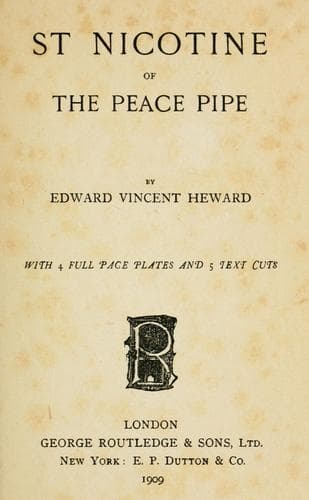
St Nicotine of the Peace PipeHeward, Edward Vincent
History
St Nicotine of the Peace Pipe
Heward, Edward Vincent
Smoking; Tobacco
As to the effects of tobacco-smoking upon the human body Sir Benjamin
Richardson would appear to see no reason for thinking that it can produce
any organic change, though it may induce various functional disturbances
if carried to excess. These are such as all young smokers experience
more or less severely, according to their temperament and the quality or
strength of the tobacco they use. There can be no question that the first
attempt at smoking reveals phenomena which plainly show that to become
one of the initiated in the service of Nicotina a certain ordeal must be
passed through if the novice would rank among her votaries. It may be
of use to remark that the stronger kinds of tobacco are the products of
the Virginian and Kentucky plantations; French tobacco too is quite as
strong, they contain from six to eight per cent. of nicotine; Maryland
and Havanna tobaccos, also those of the Levant, generally average two per
cent., while the products of Sumatra and China barely contain one per
cent. of nicotine. The general conclusion Sir Benjamin Richardson deduces
from his experiments is such as might be fairly expected from an eminent
physician of large experience, unbiassed by prejudice. In this judicial
sense he remarks that tobacco ‘is innocuous as compared with alcohol; it
does infinitely less harm than opium, it is in no sense worse than tea,
and by the side of high living altogether it compares most favourably.’
But on the question of youths smoking he speaks most decisively against
even the smallest indulgence in tobacco before the system is matured.
His words are: ‘With boys the habit is as injurious and wrong as it is
disgusting. The early “piper” loses his growth, becomes hoarse, effete,
lazy, and stunted.’
The late Professor Johnston, of Durham, gave his attention to the
subject, and in the eminently useful work on the _Chemistry of Common
Life_ he minutely describes the results he obtained from a careful
analysis of tobacco leaves. These in all essential particulars are such
as have already been mentioned. Although he points out the highly
poisonous nature of some of the constituents of tobacco, he yet speaks
regretfully of his inability to derive from smoking the soothing
pleasures mentioned by others, particularly by Dr. Pereira, who remarking
on its tranquillizing effects when moderately indulged in, says that ‘it
is because of these effects that it is so much admired and adopted by all
classes of society, and by all nations, civilised and barbarous.’ Mr.
Johnston continues:
Public-domain text, read in full here on John Shaqi.
Reviews
Reviews
No reviews yet
Be the first to share your thoughts on this work.
Elsewhere in the archive
Join the Discussion
Join the discussion
Sign in to leave a comment or review.
Sign InorCreate an account