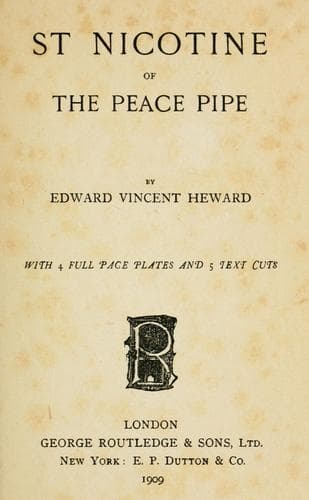
St Nicotine of the Peace PipeHeward, Edward Vincent
History
St Nicotine of the Peace Pipe
Heward, Edward Vincent
Smoking; Tobacco
The purifying action of tobacco-smoke on unwholesome air was fully
recognised in Pepys’ time, when during the Great Plague of 1665-6 the
pipe was to be seen in almost every mouth. Pepys like others sought
protection in the weed, and purchased roll-tobacco to ‘chaw.’ Alas, poor
man, it took away his apprehension! In his immortal diary is a note under
date, June 7th. 1665:
This is the hottest day that I ever felt in my life. This day,
much against my will, I did in Drury Lane, see two or three
houses marked with a red cross upon the doors, and, ‘Lord, have
mercy upon us,’ writ there, which was a sad sight to me, being
the first of the kind that to my remembrance I ever saw. It put
me in an ill-conception of myself and my smell, so that I was
forced to buy some roll-tobacco to smell and chaw, which took
away my apprehension.
Clearly Pepys was not a ‘tobacconist,’ but surely he should have known
better than to have ‘chawed’ the black twist.
Dr. Willis, physician in ordinary to Charles the Second, speaks highly
of the valuable antiseptic properties of tobacco. In his work entitled,
_A Plain and Easy Method of Preserving (by God’s Blessing) Those That
are Well From the Infection of the Plague_ (1666) he remarks upon the
exemption from the pestilence of houses where tobacco was stored for
manufacture or sale.
Nor indeed were those persons affected who smoked tobacco,
especially if they smoked in the morning, a time when the body
is more susceptible to outer influences than it is later in
the day. For the smoke of the plant secures those parts which
lie most open, namely, the mouth, nostrils, etc., and at once
intercepts and keeps the contagion that floats in the air from
the brain, lungs, and stomach. It also stirs the blood and
spirits all over, and makes them throw off any contagion that
may adhere to them.
In another treatise on the subject Dr. Willis makes equally shrewd
remarks on the use of tobacco among soldiers and sailors. He says,
‘Tobacco taken in the vulgar way at the mouth through a pipe has effects
not only manifold but diverse,’ and he explains that its use, when it
may be had, seems not only necessary but profitable for soldiers and
mariners, for that it renders them both fearless of any danger, and
patient of hunger, cold, and labour.’ Army experiences of recent years
bear testimony to the beneficial use of tobacco in almost the same words.
Public-domain text, read in full here on John Shaqi.
Reviews
Reviews
No reviews yet
Be the first to share your thoughts on this work.
Elsewhere in the archive
Join the Discussion
Join the discussion
Sign in to leave a comment or review.
Sign InorCreate an account