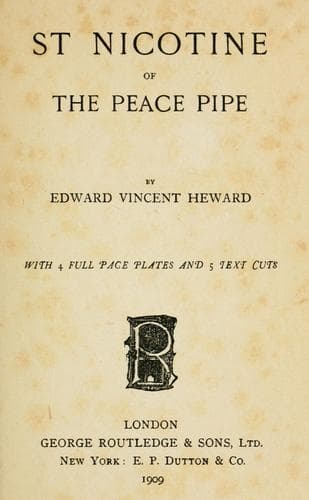
St Nicotine of the Peace PipeHeward, Edward Vincent
History
St Nicotine of the Peace Pipe
Heward, Edward Vincent
Smoking; Tobacco
Similar investigations have been made in Spain and Germany. Werke
saturated a cigar with a liquid fully impregnated with cholera bacilli
and found that in twenty-four hours every germ was destroyed. He next
placed bacilli upon dry tobacco leaves; in this case they were rendered
harmless in half an hour. In other trials a contact with the leaf of
three hours was required for their destruction. Strange to say, damp
tobacco was the least effective; the germs struggled hard for existence,
and held out for three days before yielding up their lives to the
superior genius of the weed. A fifty per cent. solution of tobacco
over-mastered them in twenty-four hours. But it is in burning tobacco,
when its elements are liberated from their confinement, that the battle
is most decisive. Werke says, that when he tested them with the smoke of
tobacco every germ was rendered incapable of propagating disease in less
than five minutes.
Though the medical man whom duty calls to densely-crowded, unwholesome
districts fortifies himself against attack from the invisible foe with a
Manila or Cuban leaf, he protests emphatically against the smoking habit
which has recently cropped up among boys. The boy-smoker, besides being
a nuisance, is rendering himself physically and mentally unfit for the
duties of life.
CHAPTER VI
ON THE ANTIQUITY OF TOBACCO-SMOKING
Like Horace’s greybeard, we are all more or less prone to look lovingly
towards the past, to regard the days of our forefathers as the good old
times in which they played their part in life’s drama on a larger and
nobler scale than we do, or are capable of doing. In this spirit of
admiration for antiquity we see the beginnings of that hero-worship which
with the Greeks gradually developed into their beautiful mythology. They,
above all other people, delighted to extol the powers and achievements
of their ancestors; they clothed them with the attributes of deity, and
strove to emulate and honour them in all manly deeds; thus they exalted
their own conceptions of life, and idealised the course of their national
existence. And yet this innate tendency to magnify and extend into the
dim, illimitable regions of antiquity whatever of human effort is deemed
most worthy, is a source of difficulty to the conscientious student.
Amid the wild growth of myth and marvel the antiquary or archæologist
warily treads his way to surer ground, and out of scattered fragments of
a by-gone age constructs anew an old order of existence, or opens a vista
to the mind’s eye through which glimpses may be gained of the habits
and inner life of our remote ancestors. Then it is we see the present
linked with the past in one unbroken chain; our knowledge is enlarged,
and we recognise the unity of our race. Needless then to say that it is
in no narrow spirit of mere curiosity that the wise men of Europe have
devoted much labour and learning to the task of discovering if the habit
Public-domain text, read in full here on John Shaqi.
Reviews
Reviews
No reviews yet
Be the first to share your thoughts on this work.
Elsewhere in the archive
Join the Discussion
Join the discussion
Sign in to leave a comment or review.
Sign InorCreate an account