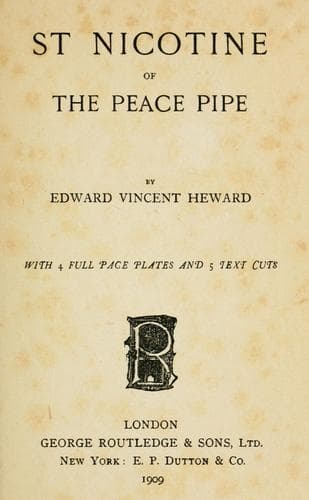
St Nicotine of the Peace PipeHeward, Edward Vincent
History
St Nicotine of the Peace Pipe
Heward, Edward Vincent
Smoking; Tobacco
The learned botanist, Meyen, speaking of China in relation to the habit
of smoking, deals with another and more pertinent aspect of the question.
‘It has long been the opinion,’ he remarks, ‘that the use of tobacco, as
well as its culture, was peculiar to the people of America; but this is
now proved to be incorrect by our present more exact acquaintance with
China and India. The consumption of tobacco in the Chinese Empire is of
immense extent, and the practice seems to be of great antiquity, for on
very old sculptures I have observed the very same tobacco-pipes which
are still used. Besides, we know the plant which furnishes the Chinese
tobacco; it is even said to grow wild in the East Indies. It is certain
that this tobacco plant of eastern Asia is quite different from the
American species.’ The tobacco grown in China is very light in colour and
almost tasteless, possessing a very small amount of the essential oil,
one or two per cent. as against seven or eight per cent. yielded by the
Virginian plant. Experiment, however, has brought to light the fact that
climate and soil are really answerable for all the difference between
the two kinds; that the _Nicotiana tabacum_ of America for example, when
transplanted into Syrian soil, has after a few years’ cultivation lost
its marked characteristics and become a light-coloured, mild tobacco,
like the Shiraz herb. Meyen’s argument would have had more value if he
had been able to assign a date to the sculpture on which he had observed
representations of tobacco-pipes, or if he himself had seen and examined
specimens of the tobacco-plant said to grow wild in the East Indies.
As his statement lacks the certainty which authenticated facts alone
can give, it leaves the question still unanswered. The two Lazarists,
MM. Gabet and Huc, whose zeal and heroic enterprise carried them safely
through the wildest districts of Tartary and Thibet, make no mention
of the practice of smoking among the inhabitants of those countries;
though in China they had noticed outside tobacconists’ shops an effigy
of the tobacco plant, which they took to be a representation of the
royal insignia of France, for they speak of it as the _fleur-de-lis_.
Doubtless China rose in their estimation when they beheld so flattering
an acknowledgment of its indebtedness to the grand nation for the
blessing the herb conferred on an unworthy people. But if such were their
impression they greatly erred. The inhabitants of the Celestial Empire
(Tin-shan) entertained notions of a very different character. Their
country (Chung-tow) occupied the centre of the earth, and all beings
outside their borders they regarded as Fan-qui, barbarian wanderers,
or outlandish demons. The exalted ideas they had formed of themselves
led them into the happy delusion that they were the lower empire of the
celestial universe. ‘In the heavens,’ says M. Pingré, ‘they beheld a
vast republic, an immense empire, composed of kingdoms and provinces;
Public-domain text, read in full here on John Shaqi.
Reviews
Reviews
No reviews yet
Be the first to share your thoughts on this work.
Elsewhere in the archive
Join the Discussion
Join the discussion
Sign in to leave a comment or review.
Sign InorCreate an account