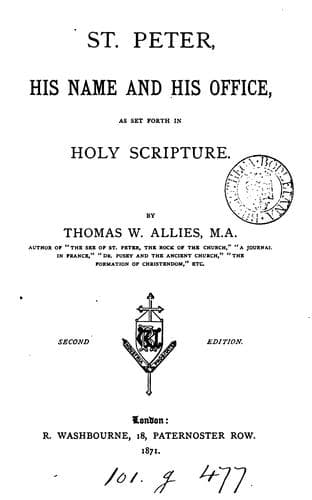
St. Peter, His Name and His Office, as Set Forth in Holy ScriptureAllies, T. W. (Thomas William)
Religion
St. Peter, His Name and His Office, as Set Forth in Holy Scripture
Allies, T. W. (Thomas William)
Peter, the Apostle, Saint
For, as to the third[29] occasion, Luke, after mentioning Peter and
John together, introduces Peter alone as urging the children of
Abraham to embrace the faith of Christ, and persuading them that
Jesus is the Prophet, promised by God through Moses in Deuteronomy.
And as to the fourth,[30] he writes, "Then Peter, filled with the
Holy Ghost, said to them--" But was he alone present? not so, for
the council "setting them," not him, but John as well as Peter, "in
the midst, they asked," on which Chrysostome[31] observes, "See how
John is on every occasion silent, while Peter defends him likewise."
That is, John was silent, as knowing that the lead belonged to
Peter, and Peter spoke, because the Head defends not himself only,
but the members committed to him.
Now, reviewing these first four chapters of the Acts, let us ask
these questions. Had Peter held the authority of head among the
Apostles, what would he have done? He would have filled up the
Apostolic college, carefully watched over it, protected its several
members. But this is just what he did. Again, had Christ made him
the supreme teacher and doctor, what would he have done? He would
have disclosed, first to the Apostles themselves, and to the
disciples, and then to the multitude, who were to be converted, the
secrets of the divine will laid up in the Scriptures; he would have
shown the agreement between the dispensation of Christ, and the
oracles of the Old Testament, and so have proved that Jesus was the
Messiah. But this he repeatedly did. Once more, had Christ made him
the chief among the builders of the Church, what would have been his
office? He would have been the very first to set his hand to the
work, and to construct the building with living stones; he would
have held the other workmen under his control, so that the edifice
might rise worthy of Christ, and exactly answering to His promises.
But does not the history give precisely this picture of him, and
does not the Church which Peter raised answer exactly to the
archetype prescribed by the Lord? "All they that believed were
together, and had all things common:" "the multitude of believers
had but one heart and one soul:" what is this but the counterpart of
that divine prayer, "that they all may be one, as Thou, Father, art
in Me, and I in Thee, that they also may be one in Us, that the
world may believe that Thou hast sent[32] Me."
Public-domain text, read in full here on John Shaqi.
Reviews
Reviews
No reviews yet
Be the first to share your thoughts on this work.
Elsewhere in the archive
Join the Discussion
Join the discussion
Sign in to leave a comment or review.
Sign InorCreate an account