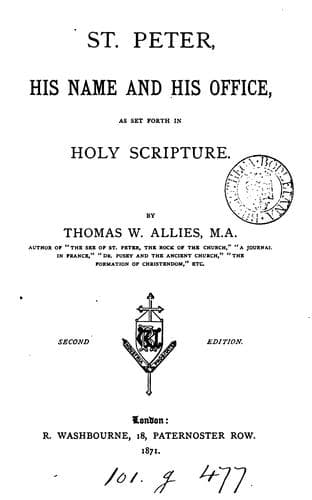
St. Peter, His Name and His Office, as Set Forth in Holy ScriptureAllies, T. W. (Thomas William)
Religion
St. Peter, His Name and His Office, as Set Forth in Holy Scripture
Allies, T. W. (Thomas William)
Peter, the Apostle, Saint
But in the meantime, while the messengers of Cornelius were
approaching the house in which Peter was a guest, "there came upon
him an ecstasy of mind, and he saw the heaven opened, and a certain
vessel descending, as it were a great linen sheet let down by the
four corners from heaven to the earth, wherein were all manner of
four-footed beasts, and creeping things of the earth, and fowls of
the air;" and while Peter is fixed in contemplation, "there came a
voice to him, Arise Peter, kill and eat," that he might understand
how "by[49] his preaching he was to make a sacrifice to the Lord of
those who were represented by these animals, bringing them into the
divine service through the mysteries of the Lord's passion," which
he not yet understanding, replies, "Far be it from me, for I never
did eat anything that is common or unclean." Then the heavenly
"voice spoke to him again the second time, That which God hath
cleansed, do not thou call common. And this having been done thrice,
presently the vessel was taken up into heaven."
Here three things are set forth; first, that as the ark of Noah
contained all sorts of animals, clean and unclean, so the fold of
Christ was to gather from Jews and Greeks and barbarians "a[50]
great multitude, which no man could number, of all nations and
tribes, and peoples, and tongues;" secondly, that the blessings of
Christ concerned all who did not reject the proferred grace;
thirdly, that the elaborate system of Mosaic ordinances concerning
meats, rites, and ceremonies, had fallen to the ground. But to whom
is disclosed, first and immediately, this whole dispensation of the
first principles on which the Church was to be propagated? To none
other but Peter, "to me hath God shown to call no man common or
unclean." Now the undoubted knowledge of this dispensation must
appear of the greatest moment, whether in itself, or as concerns the
Jews, of whom the earliest church consisted, or the Apostles, by
whose ministry it was to be extended. And yet, by that providence
which is ever over His Church, the wisdom of God so ruled it, that
through Peter alone the Apostles should be taught when they were
first to approach the Gentiles, and discharge their office of
witnesses before all nations without distinction. And that because
He had made Peter "the greater one" and "the leader" of all, and put
him in His own place, and constituted him supreme teacher in these
words, "Confirm thy brethren." Thus[51] Epiphanius, in the fourth
century, says that the charge of bringing the Gentiles into the
Church was laid upon all the Apostles, "but most of all on holy
Peter." Why this _most of all_? Because, while He had heard with the
rest, "make disciples of all nations," he had singly and peculiarly
received the charge of the whole fold, and of the Apostles, as part
of it.
Public-domain text, read in full here on John Shaqi.
Reviews
Reviews
No reviews yet
Be the first to share your thoughts on this work.
Elsewhere in the archive
Join the Discussion
Join the discussion
Sign in to leave a comment or review.
Sign InorCreate an account