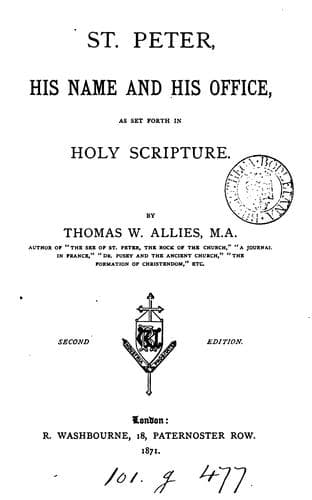
St. Peter, His Name and His Office, as Set Forth in Holy ScriptureAllies, T. W. (Thomas William)
Religion
St. Peter, His Name and His Office, as Set Forth in Holy Scripture
Allies, T. W. (Thomas William)
Peter, the Apostle, Saint
For, to prove this, let us go back once more to witnesses beyond
suspicion, who wrote a thousand years before the denial of Peter's
Primacy began. The Greek and Latin Fathers see here a recognition of
his chief authority. Thus Theodoret, "Not needing doctrines from
man, as having received it from the God of all, he gives the fitting
honour to the chief." Theodoret follows S. Chrysostome, who had
said, "After so many great deeds, needing nothing of Peter, nor of
his instruction, but being his equal in rank, for I will say no more
here, still he goes up to him as to the greater and elder:" his
equal in the Apostolic dignity, and the immediate reception of his
authority from Christ, but yet his inferior in the range of his
jurisdiction, Peter being "greater and elder." And he goes on, "he
went, but for this alone, to see him and honour him by his presence.
He says, I went up to visit Peter. He said not to see Peter, but to
visit Peter, as they say, in becoming acquainted with great and
illustrious cities. So much pains he thought it worth only to see
the man." And he concludes, "This I repeat, and would have you
remember, lest you should suspect the Apostle, on hearing anything
which seems said against Peter. For it was for this that he so
speaks, correcting by anticipation, that when he shall say, I
resisted Peter, no one may think these words of enmity and
contention. For he honours the man, and loves him more than all. For
he says that he came up for none of the Apostles, save him."
Elsewhere, S. Chrysostome, commenting on the charge, Feed My sheep,
asks, "Why, then, passing by the rest, does He converse with him
(Peter) on these things?" And he replies, Peter "was the one
preferred among the Apostles, and the mouth-piece of the disciples,
and the head of the band: _therefore_, too, Paul then went up to
visit him _rather than the rest_."[10] Tertullian, the most ancient
of the Latins, says, "then, as he relates himself, he went up to
Jerusalem for the purpose of becoming acquainted with Peter, that
is, according to duty, and the claim of their identical faith and
preaching:"[11] the _duty_, which Paul had to Peter; the _claim_
which Peter had on Paul. In the fourth century, Marius Victorinus
observes: "After three years, says he, I came to Jerusalem; then he
adds the cause, to see Peter. For if the foundation of the Church
was laid in Peter, as is said in the Gospel, Paul, to whom all
things had been revealed, knew that he was _bound_ to see Peter, as
one to whom so great an authority had been given by Christ, not to
learn anything from him."[12] The writer called Ambrosiaster, as his
works are attached to those of S. Ambrose, and contemporary with
Pope Damasus, (A.D. 366-384) remarks, "It was proper that he should
desire to see Peter, because he was first among the Apostles, to
whom the Saviour had committed the care of the Churches." S. Jerome,
more largely, says, "not to behold his eyes, his cheeks, or his
Public-domain text, read in full here on John Shaqi.
Reviews
Reviews
No reviews yet
Be the first to share your thoughts on this work.
Elsewhere in the archive
Join the Discussion
Join the discussion
Sign in to leave a comment or review.
Sign InorCreate an account