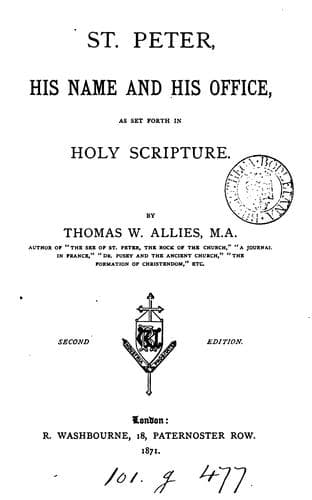
St. Peter, His Name and His Office, as Set Forth in Holy ScriptureAllies, T. W. (Thomas William)
Religion
St. Peter, His Name and His Office, as Set Forth in Holy Scripture
Allies, T. W. (Thomas William)
Peter, the Apostle, Saint
Peter's dignity more remarkably than to exhibit him in the same
light of superiority among the original Apostles, as S. Paul was
among S. Barnabas and his other fellow-workers?
Further confirmation of this is given by the argument with which he
refutes the calumny urged against him of disagreement with the
Apostles. For while he appeals to them _in general_, and to his
union with them, he likewise _specifies_ the point which favoured
that union. It was the parallel between himself and Peter, as we
have seen; it was the exact resemblance between his mission and that
of Peter, which was the cause of their joining hands: they approve
Paul's Apostleship because they see that it follows the type of
Peter's.
And other words of Paul which follow, prove not only the point of
his own cause, but the source of Peter's singular privileges. "But
when Cephas was come to Antioch, I withstood him to the face,
because he was to be blamed: for before that some came from James,
he did eat with the Gentiles; but when they were come he withdrew,
and separated himself, fearing them who were of the circumcision.
And to his dissimulation the rest of the Jews consented, so that
Barnabas also was led by them into that dissimulation. But when I
saw that they walked not uprightly unto the truth of the Gospel, I
said to Cephas before them all, If thou being a Jew livest after the
manner of the Gentiles, and not as the Jews do, how dost thou compel
the Gentiles to live as the Jews?" For why did Paul here censure
Peter _only_? By his own account not only Peter, but the rest, and
Barnabas himself amongst them, set apart as he was by the Holy Ghost
to preach to the Gentiles, did not defend Christian liberty, as they
ought to have done. Why, then, does he single out Peter among all
these, resist him to the face, and so firmly censure all, in his
person? No answer can be given but one: that by this dissembling of
Peter the zealots of the law gathered double courage to press
against Paul their calumny of dissension from Peter, and to infer
that he had run in vain, from the indulgence which Peter showed;
that Peter's authority with all was so great that his example drew
the pastors and their flocks alike to his side, and that it was
requisite to correct the members in the head. From this S.
Chrysostome proves that it was really the Apostle Peter, which some,
as we shall soon see, denied: "For to say, that I resisted him to
the face, and to put this as a great thing, was to show that he had
not reverenced the dignity of his person. But had he said it of
another, that I resisted him to the face, he would not have put it
as a great thing. Again, if it had been another Peter, his change
would have not had such force as to draw the rest of the Jews with
him. For he used no exhortation, nor advice, but merely dissembled,
and separated himself, and that dissembling and separation had
power to draw after him all the disciples, _on account of the
Public-domain text, read in full here on John Shaqi.
Reviews
Reviews
No reviews yet
Be the first to share your thoughts on this work.
Elsewhere in the archive
Join the Discussion
Join the discussion
Sign in to leave a comment or review.
Sign InorCreate an account