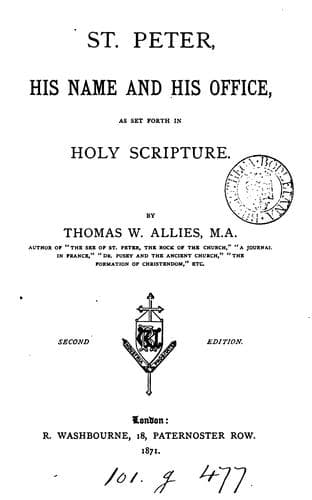
St. Peter, His Name and His Office, as Set Forth in Holy ScriptureAllies, T. W. (Thomas William)
Religion
St. Peter, His Name and His Office, as Set Forth in Holy Scripture
Allies, T. W. (Thomas William)
Peter, the Apostle, Saint
But now, though all the sons of Israel in the former typical kingdom
were chiefs, and heads of tribes, yet one of them, that is Judah,
had a special prerogative, which the Scriptures set forth, and which
was called the _right of the first-born_. In virtue of this, on the
one hand, Judah was esteemed the Lord of his brethren, whom they
were to reverence as the parent of the whole family, and on the
other, it was only by union with him, and with the seed that was to
spring from him, that the other chiefs could promise to themselves
the divine blessing. And so the tribe of Judah had a great
pre-eminence over the other eleven. It was its prerogative to take
the[5] lead: it had received from God the promise of an[6] authority
which was not to terminate before the old covenant should be
transformed into the new: from it was the seed[6] to be expected,
which should be the source of blessing to all nations, prefigured as
they were by the twelve tribes; the other tribes were bound[7] to
union with it, and to the profession of its religion, on pain of
falling into schism, and forfeiting the divine covenant. All this
was expressed by Jacob in prophetic inspiration, when he addressed
Judah as the head and root of his line: "Judah (praise) art thou,
thy brethren shall praise thee: thy hand is on the neck of thine
enemies: the sons of thy father shall bow down to thee." It remains,
then, to ask, who was to represent Judah's person in the new
kingdom, and on whom Christ bestowed the prerogative, the type and
image of which had gone before in Judah. It is most plain that this
was Simon Peter, for whom we have, therefore, to claim a double
prerogative, the one of being the source and origin, from which no
one may be separated without severance from the kingdom and promises
of Christ: the other of being the first-born, as betokening
excellence, by which he was pre-eminent in the possession of special
rights among his brethren, the Apostles.
The former prerogative was expressed by the Fathers of Aquileia,
when, in the words of S. Ambrose, they stated their belief in S.
Peter's chair, "For thence, as from a fountain head, the rights of
venerable communion flow unto[8] all." The latter is confirmed and
illustrated by the solemn expressions so often recurring in
Christian records, wherein Peter is called, "[9]the Bishop of
Bishops," "[10]the Pastor of Pastors," "[11]first prelate of the
Apostles," "[12]Patriarch of the whole world," "[13]universal
bishop," "[14]father of fathers," "[14]having the dignity of
pastoral headship," "[14]the most divine head of all heads,
arch-pastor of the Church."
Public-domain text, read in full here on John Shaqi.
Reviews
Reviews
No reviews yet
Be the first to share your thoughts on this work.
Elsewhere in the archive
Join the Discussion
Join the discussion
Sign in to leave a comment or review.
Sign InorCreate an account