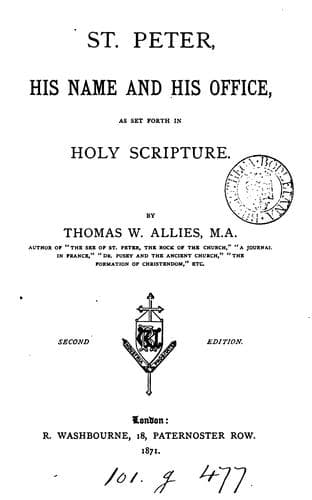
St. Peter, His Name and His Office, as Set Forth in Holy ScriptureAllies, T. W. (Thomas William)
Religion
St. Peter, His Name and His Office, as Set Forth in Holy Scripture
Allies, T. W. (Thomas William)
Peter, the Apostle, Saint
It was His will to appoint one to take His place on earth. Now He
had assumed to Himself specially a particular title, under which of
old time His prophets had foretold His advent among men, and which
above all others expressed His tender love for fallen man. It had
been said of Him, "I will set up one shepherd over them, and He
shall feed them, even my servant David: He shall feed them, and He
shall be their shepherd." And again: "Say to the cities of Judah,
behold your God.--He shall feed His flock like a shepherd: He shall
gather together the lambs with His arm, and shall take them up in
His bosom, and He Himself shall carry them that are with young."
And, once more, in the very prophecy by which the chief priests and
scribes declared to Herod that He must be born at Bethlehem, "For
from thee shall go forth the ruler, who shall feed (or shepherd) My
people Israel." Appropriating these predictions to Himself, the Lord
had said: "I am the good shepherd.[14] The good shepherd giveth His
life for His sheep. And other sheep I have which are not of this
fold; them also I must bring; and there shall be one fold and one
shepherd." And now it was His pleasure to give this particular
title, so specially His own, to Peter, and to Peter alone, and to
Peter in most marked contrast even with the best beloved of His
other disciples, and to Peter, thrice repeating the charge, and
varying the expression of it so as to include the term in its utmost
force. "When, therefore, they had dined, Jesus said to Simon Peter,
Simon, son of John, lovest thou Me more than these? He saith to Him,
Yea, Lord, Thou knowest that I love Thee. He saith to him, Feed My
lambs. He saith to him again, Simon, son of John, lovest thou Me? He
saith to Him, Yea, Lord, Thou knowest that I love Thee. He saith to
him, Feed My lambs. He saith to him the third time, Simon, son of
John, lovest thou Me? Peter was grieved because He had said to him
the third time, lovest thou Me? And he said to Him, Lord, Thou
knowest all things: Thou knowest that I love Thee. He said to him,
Feed My sheep."
Our Lord had before addressed the seven disciples present in common,
"Children, have you any meat?" "Cast the net, and you shall find."
"Bring hither of the fishes which you have now caught." "Come and
dine." But now, turning to one in particular, He singles him out in
the most special manner, by his name, by asking of him a love
greater than that of any others towards Himself, by conferring on
him a charge, which, as we shall see, from its extension excludes
its being held in joint possession by any other, and by a prophecy
concerning the manner of his death, which is wholly particular to
Peter. If it is possible by any words to convey a power and a charge
to a particular person, and to exclude the rest of the company from
that special power and charge, it is done here.
Public-domain text, read in full here on John Shaqi.
Reviews
Reviews
No reviews yet
Be the first to share your thoughts on this work.
Elsewhere in the archive
Join the Discussion
Join the discussion
Sign in to leave a comment or review.
Sign InorCreate an account