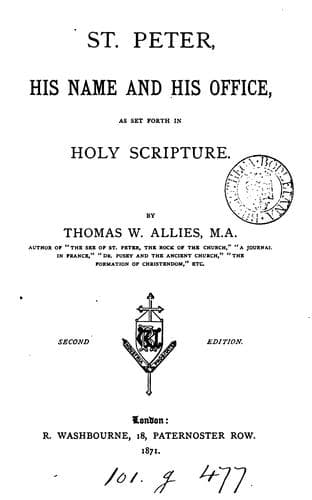
St. Peter, His Name and His Office, as Set Forth in Holy ScriptureAllies, T. W. (Thomas William)
Religion
St. Peter, His Name and His Office, as Set Forth in Holy Scripture
Allies, T. W. (Thomas William)
Peter, the Apostle, Saint
But, secondly, it is a charge of a very high and distinguishing
nature indeed, for our Lord before conferring it demands of Peter,
as a condition, greater love towards His own person than that felt
for Him by any of the Twelve--even by the sons of Zebedy, whom from
their zeal He surnamed Boanerges, sons of thunder--even by the
disciple whom He loved, and who lay on His breast at the last
supper. What must that charge be, the preliminary condition for
which is a greater love for Jesus than that of the beloved disciple?
What shall be a fitting sequel to "Simon, son of John, lovest thou
me _more_ than these?" What, again, the importance of that office,
in bestowing which our Lord thrice repeats the condition, and thrice
inculcates the charge? The words of God are not spoken at random,
nor His repetitions without effect. What, again, are the _subjects_
of the charge? They are "My lambs," and "My sheep," that is, the
fold itself of the Great Shepherd. As He said, "If I wash thee not,
thou shalt have no part with Me," so those who are not either His
lambs or His sheep, form no part of His fold. Others, too, in Holy
Writ, are addressed as shepherds, but with a limitation, as, "Take
heed to the whole flock _wherein_ the Holy Ghost hath placed you
bishops," or "feed the flock of God _which is among you_." And, more
largely far it was said, "Go ye, therefore, and make disciples all
nations;" and "Go ye into the whole world and preach the Gospel to
every creature."[15] But they to whom this was said were yet
themselves sheep of the Great Shepherd, and in committing the world
to them, He did not commit _them_ to each other. Whereas here, they
too, as His sheep, are committed to one, even Peter; and very
expressly, in the persons of James and John, and the rest present,
"lovest thou Me more than these?" A particular flock is never
termed absolutely and simply "the flock," or "the flock of God," but
"the flock _which is among you_," "_in which the Holy Ghost hath
made you bishops_." And, again, the Apostles are sent in common to
the whole world, to preach to all nations, and to form one flock;
but they are twelve, and "power given to several carries its
restriction in its division, whilst power given to one alone and
over all, and without exception, carries with it plenitude, and, not
having to be divided with any other, it has no bounds save those
which its terms convey."[16] What are the terms here? "Feed," and
"be shepherd over" or "rule" "My lambs and My sheep." The terms have
no limit, save that of salvation itself. Such, then, are the
_persons_ indicated as subjects of this charge. But what is the
nature of the charge? Two different words of unequal extent and
force in the original, but both rendered "feed" in the translation,
convey this. One means "to give food" simply, the other, of far
higher and nobler reach, embraces every act of care and providence
in the government of others, under an image the farthest removed
Public-domain text, read in full here on John Shaqi.
Reviews
Reviews
No reviews yet
Be the first to share your thoughts on this work.
Elsewhere in the archive
Join the Discussion
Join the discussion
Sign in to leave a comment or review.
Sign InorCreate an account