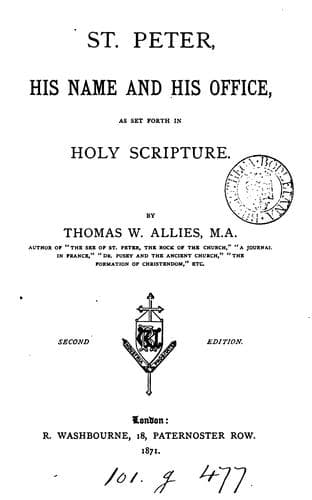
St. Peter, His Name and His Office, as Set Forth in Holy ScriptureAllies, T. W. (Thomas William)
Religion
St. Peter, His Name and His Office, as Set Forth in Holy Scripture
Allies, T. W. (Thomas William)
Peter, the Apostle, Saint
authority over all, from the very God for our sakes incarnate:"[27]
thus he followed in the steps of the Good Shepherd, as he succeeded
to His office. And, therefore, having accomplished his mission and
triumphed on the Roman hill, from Rome he speaks through the undying
line of his spiritual heirs, and feeds the flock of Christ.
FOOTNOTES:
[1] Passaglia, p. 93.
[2] Matt. xvi. 16.
[3] Matt. x. 1; Mark iii. 13-15; Luke vi. 12-13; Matt. xviii, 18.
[4] John xvii. 12.
[5] Mark xvi. 6.
[6] 1 Cor. xv. 1-9.
[7] Matt. xxviii. 18; Mark xvi. 15; Luke xxiv. 49; Acts i. 4-8;
John. xx. 21.
[8] De unitate ecclesiae, 3.
[9] Mark i. 16; Luke v. 3.
[10] Mark iv. 38; Luke viii. 24.
[11] John vi. 21.
[12] John xxi. 1-14.
[13] St. Augustine's 122nd discourse on St. John, who has thus set
forth this chapter: "Piscis assus Christus est passus."
[14] Ezech. xxiv. 33; Isai. xl. 9-11; Mich. v. 2; Matt. ii. 6; John
x. 11, 14, 16.
[15] Acts xx. 28; 1 Pet. v. 10; Matt. xxviii. 19; Mark xvi. 15.
[16] Bossuet, sermon on unity.
[17] Acts xx. 28; 1 Pet. v. 10; Ps. ii. 9; Apoc. xix. 15; ii. 27.
[18] Poimahinein used in the text of John, and in all
these.
[19] Bossuet, sermon on unity.
[20] St. Jerome.
[21] Amoris sui veluti vicarium.
[22] In Lucam, Lib. 10, n. 175.
[23] St. Chrys. in Joan. Hom. 88, p. 525-7; and De Sacerdot. Lib. 2,
Tom. 1. p. 372.
[24] St. Leo. Serm. 4.
[25] St. Basil, Constit. Monas. xxii. Tom. 2, p. 573.
[26] St. Cyprian, de unit. 3.
[27] Stephen of Dora, in the Lateran Synod, A.D., 649. Mansi, x.
893.
CHAPTER IV.
THE CORRESPONDENCE AND EQUIVALENCE OF THE GREAT TEXTS CONCERNING
PETER.
Before we compare together more exactly what was said to the
Apostles in common, and what to Peter in particular, it is desirable
to consider briefly two other points, which will complete the
evidence furnished by the Gospels.
1. If, then, the[1] question to be decided by documents is, whether
several persons are to be accounted equal in rank, honour, and
authority, or whether one of them is superior to the rest, it will
be an unexceptionable rule to observe whether they are spoken of in
the same manner. For words are signs of ideas, and set forth as in a
mirror the mind's conceptions. A similarity of language, therefore,
will indicate a similarity of rank; a distinction of language,
especially if it be repeated and constant, will show a like
distinction of rank. Let us apply this rule to the mode in which the
Evangelists speak of Peter and of the other Apostles.
Public-domain text, read in full here on John Shaqi.
Reviews
Reviews
No reviews yet
Be the first to share your thoughts on this work.
Elsewhere in the archive
Join the Discussion
Join the discussion
Sign in to leave a comment or review.
Sign InorCreate an account