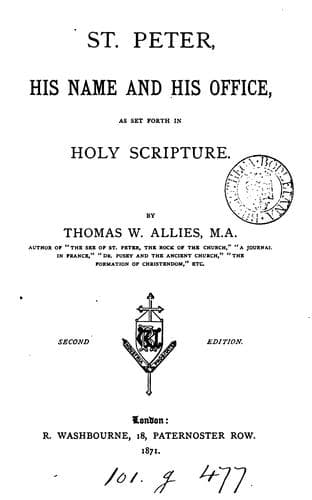
St. Peter, His Name and His Office, as Set Forth in Holy ScriptureAllies, T. W. (Thomas William)
Religion
St. Peter, His Name and His Office, as Set Forth in Holy Scripture
Allies, T. W. (Thomas William)
Peter, the Apostle, Saint
significant is the incident immediately following, when our Lord
orders him to go to the sea, to cast a hook, and to bring up a fish,
which shall have a stater in his mouth, adding, "take that, and give
it to them for Me, and for thee:" a token of preference so strong,
and of association so singular, that it set the Apostles on the
immediate enquiry, who should be the greater among them: the answer
to which we will revert to presently.
And this designation of Peter to his high and singular office
becomes even more striking, if we contrast what our Lord did and
said to him with what He did and said to another Apostle, who _in
another way_ is even in some respects preferred to Peter himself.
For "the disciple whom Jesus loved," who lay on His breast at
supper, to whom was committed at the most sorrowful of all moments
the domestic care of the Virgin Mother, has in the affection of our
Lord his own unapproachable sphere. But as Peter does not come into
competition with him here, so neither in another view he with Peter.
His distinction is private, and in the nature of personal affection:
Peter's is public, and in the nature of Church government. To one is
committed the Mother of the Lord, the living symbol of the Church,
the most blessed of all creatures, and that, when her full dignity
and blessedness stood at length revealed in the full Godhead of her
Son, yet whose throne was intercessory, apart from rule on earth: to
the other is committed the Church herself, her championship in the
time of conflict, the rudder of the vessel on the lake, till with
Christ it should reach the shore. Each of these, so eminent and
unapproachable in his way, has that way apart; and when Peter, on
receiving his final commission, turned about and saw his best-loved
friend following, and ventured to ask, "Lord, and what shall this
man do?" our Lord replied with something like a reproof, "what is
that to thee? Follow thou Me." These distinct preferences of the two
Apostles were indicated by Tertullian, when he wrote, "Was anything
concealed from Peter, who was named the rock on which the Church
should be built, who received the keys of the kingdom of heaven, and
the power to bind and loose in heaven and on earth? Was anything,
too, concealed from John, the most beloved of the Lord, who lay
upon His breast, to whom alone the Lord foresignified the traitor
Judas, whom He committed in His own place as Son to Mary?"[13]
Public-domain text, read in full here on John Shaqi.
Reviews
Reviews
No reviews yet
Be the first to share your thoughts on this work.
Elsewhere in the archive
Join the Discussion
Join the discussion
Sign in to leave a comment or review.
Sign InorCreate an account