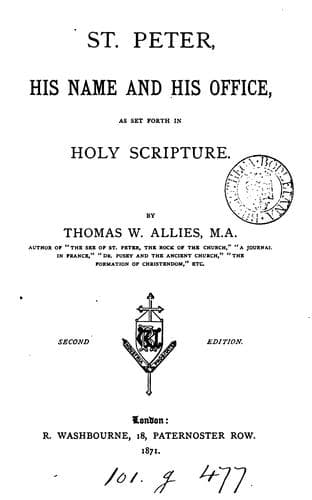
St. Peter, His Name and His Office, as Set Forth in Holy ScriptureAllies, T. W. (Thomas William)
Religion
St. Peter, His Name and His Office, as Set Forth in Holy Scripture
Allies, T. W. (Thomas William)
Peter, the Apostle, Saint
like an equal, but a superior, to anticipate the rest, to represent
them, to speak and act for them. S. Chrysostome drew the conclusion
long ago. "What then says Peter, the mouth-piece of the Apostles?
Everywhere impetuous as he is, the leader of the band of the
Apostles, when a question is asked of all, he replies."[20] No
other cause can be assigned for the care of the Evangelists in
setting before us so continually his words and acts, in bringing him
out, as the second object, after Christ. But though his future place
in the Church is a reason for this, and this again, a token of that
singular pre-eminence, its decisive proof rests on declarations from
our Lord's own mouth, expressly circumscribed to him, of singular
lucidity, and of force which nothing can evade; declarations which
set forth, under different but coincident images, a power supreme
and without equal, and of its own nature belonging to but one at a
time. The proofs which we have hitherto mentioned take away all
abruptness from these declarations, and show that they embody a
great design which runs all through the Gospel; but the office
itself rests upon these, and by these is most clearly and absolutely
defined.
Thus, when our Lord, in answer to a great confession of His Apostle,
"Thou art the Christ, the Son of the living God," replies, "and I
too, say unto thee, Thou art Peter, and upon this rock I will build
My Church:" every one must feel how it adds to the cogency of the
reply, that the name, which He is explaining, was not the person's
natural name, but first promised, and then given, by that same Lord,
who now attaches other promises and prophecies to it. This fact
serves, among others, to fix the whole which follows to Peter
individually, and to introduce what follows, as part of a design,
which before had been intimated: for what follows no more belongs to
the other Apostles, than the name, Peter, belongs to them: and a
name, on the other hand, so promised, and so given, naturally looks,
as it were, to such a result. To say solemnly of a man, when first
seen, "Thou art called Simon, but thou shall be called The Rock,"
and to make nothing of him when so called, would be, if ascribed to
any one, a dull and pointless thing; but what shall we say, when the
speaker is God? It is a new thing for God the Word to speak with
little meaning, or to speak, and not to do: and so now He does what
He had long designed. And what is it that He does? He sets up a
governor who is never to be put down. He inaugurates a Church
against which Hell shall rage, but in vain: He establishes a
government at which the nations shall rage, the kings of the earth
set themselves, and the rulers take counsel together, for ever, but
to their own confusion. He does what He alone could do, and so the
answer is worthy of the confession, "Thou art the Christ, the Son of
the living God."
Public-domain text, read in full here on John Shaqi.
Reviews
Reviews
No reviews yet
Be the first to share your thoughts on this work.
Elsewhere in the archive
Join the Discussion
Join the discussion
Sign in to leave a comment or review.
Sign InorCreate an account