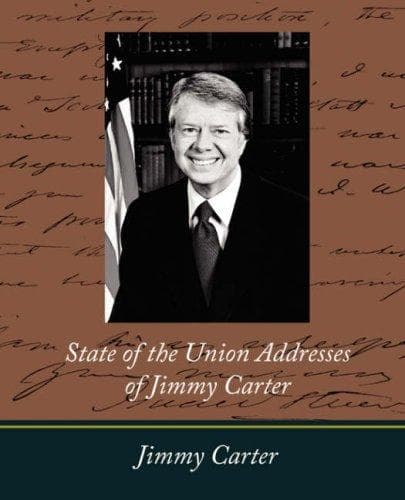
Presidents -- United States -- Messages; United States -- Politics and government -- Sources
The destruction of the independence of the Afghanistan government and the
occupation by the Soviet Union have altered the strategic situation in that
part of the world in a very ominous fashion. It has significantly shortened
the striking distance to the Indian Ocean and the Persian Gulf for the
Soviet Union.
It has also eliminated a buffer between the Soviet Union and Pakistan and
presented a new threat to Iran. These two countries are now far more
vulnerable to Soviet political intimidation. If that intimidation were to
prove effective, the Soviet Union could control an area of vital strategic
and economic significance to the survival of Western Europe, the Far East,
and ultimately the United States.
It has now been over a year since the Soviet invasion of Afghanistan dealt
a major blow to U.S.-Soviet relations and the entire international system.
The U.S. response has proven to be serious and far-reaching. It has been
increasingly effective, imposing real and sustained costs on the U.S.S.R.'s
economy and international image.
Meanwhile, we have encouraged and supported efforts to reach a political
settlement in Afghanistan which would lead to a withdrawal of Soviet forces
from that country and meet the interests of all concerned. It is Soviet
intransigence that has kept those efforts from bearing fruit.
Meanwhile, an overwhelming November resolution of the United Nations
General Assembly on Afghanistan has again made clear that the world has not
and will not forget Afghanistan. And our response continues to make it
clear that Soviet use of force in pursuit of its international objectives
is incompatible with the notion of business-as-usual.
BILATERAL COMMUNICATION
U.S.-Soviet relations remain strained by the continued Soviet presence in
Afghanistan, by growing Soviet military capabilities, and by the Soviets'
apparent willingness to use those capabilities without respect for the most
basic norms of international behavior.
But the U.S.-Soviet relationship remains the single most important element
in determining whether there will be war or peace. And so, despite serious
strains in our relations, we have maintained a dialogue with the Soviet
Union over the past year. Through this dialogue, we have ensured against
bilateral misunderstandings and miscalculations which might escalate out of
control, and have managed to avoid the injection of superpower rivalries
into areas of tension like the Iran-Iraq conflict.
POLAND
Public-domain text, read in full here on John Shaqi.
Reviews
Reviews
No reviews yet
Be the first to share your thoughts on this work.
Elsewhere in the archive
Join the Discussion
Join the discussion
Sign in to leave a comment or review.
Sign InorCreate an account