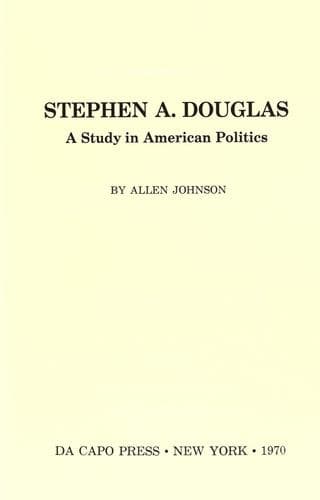
Stephen A. Douglas: A Study in American PoliticsJohnson, Allen
History
Stephen A. Douglas: A Study in American Politics
Johnson, Allen
Douglas, Stephen A. (Stephen Arnold), 1813-1861
The dictated statement read as follows: "The Quincy _Whig_ and other
Whig papers are publishing an article purporting to be copied from a
Mississippi paper abusing Judge Douglas as the owner of 100 slaves
and at the same time accusing him of being a Wilmot Free-soiler. That
the article originated in this State, and was sent to Mississippi for
publication in order that it might be re-published here we shall not
question nor take the trouble to prove. The paternity of the article,
the malice that prompted it, and the misrepresentations it contains
are too obvious to require particular notice. If it had been written
by a Mississippian he would have known that the statement in regard to
the ownership of the negroes was totally untrue. No one will pretend
that Judge Douglas has any other property in Mississippi than that
which was acquired in the right of his wife by inheritance upon the
death of her father, and anyone who will take the trouble to examine
the statutes of that State in the Secretary's office in this City will
find that by the laws of Mississippi all the property of a married
woman, whether acquired by will, gift or otherwise, becomes her
separate and exclusive estate and is not subject to the control or
disposal of her husband nor subject to his debts. We do not pretend to
know whether the father of Mrs. Douglas at the time of his death owned
slaves in Mississippi or not. We have heard the statement made by the
Whigs but have not deemed it of sufficient importance to inquire into
its truth. If it should turn out so, in no event could Judge Douglas
become the owner or have the disposal of or be responsible for them.
The laws of the State forbid it, and also forbid slaves under such
circumstances from being removed without or emancipated within the
limits of the State."
Born a Yankee, bred a Westerner, wedded to the mistress of a Southern
plantation, Douglas represented a Commonwealth whose population was
made up of elements from all sections. The influences that shaped his
career were extraordinarily complex. No account of his subsequent
public life would be complete, without reference to the peculiar
social and political characteristics of his constituency.
Public-domain text, read in full here on John Shaqi.
Reviews
Reviews
No reviews yet
Be the first to share your thoughts on this work.
Elsewhere in the archive
Join the Discussion
Join the discussion
Sign in to leave a comment or review.
Sign InorCreate an account