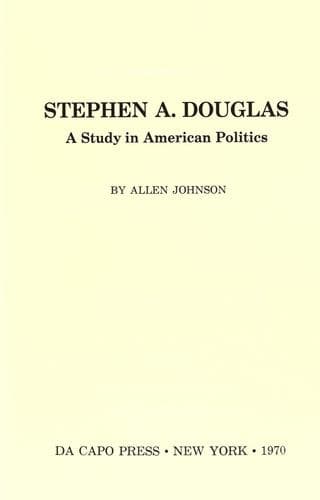
Stephen A. Douglas: A Study in American PoliticsJohnson, Allen
History
Stephen A. Douglas: A Study in American Politics
Johnson, Allen
Douglas, Stephen A. (Stephen Arnold), 1813-1861
When Illinois was admitted to the Union in 1818, all the organized
counties lay to the south of the projected national road between Terre
Haute and Alton, hence well within the sphere of surrounding Southern
influences. The society of Illinois was at this time predominantly
Southern in its origin and characteristics.[303] Social life and
political thought were shaped by Southern life and Southern thought.
Whatever points of contact there were with the outside world were with
the Southern world. The movement to make Illinois a slave State was
motived by the desire to accelerate immigration from the South.
But people had already begun to come into the State who were not of
Southern origin, and who succeeded in deflecting the current of
Illinois politics at this critical juncture. The fertile river bottoms
and intervening prairies of southern Illinois no longer sufficed. The
new comers were impelled toward the great, undulating prairies which
expand above the 39th parallel. The rise of new counties marks the
volume of this immigration;[304] the attitude of the older settlers
toward it, fixes sufficiently its general social character. This was
the beginning of the "Yankee" invasion, New York and Pennsylvania
furnishing the vanguard.
As the northern prairies became accessible by the lake route and the
stage roads, New England and New York poured a steady stream of
homeseekers into the Commonwealth. By the middle of the century, this
Northern immigration had begun to inundate the northern counties and
to overflow into the interior, where it met and mingled with the
counter-current. These Yankee settlers were viewed with hostility, not
unmixed with contempt, by those whose culture and standards of taste
had been formed south of Mason and Dixon's line.[305]
This sectional antagonism was strengthened by the rapid commercial
advance of northern Illinois. Yankee enterprise and thrift worked
wonders in a decade. Governor Ford, all of whose earlier associations
were with the people of southern Illinois, writing about the middle of
the century, admits that although the settlers in the southern part of
the State were twenty, thirty, forty, and fifty years in advance, on
the score of age, they were ten years behind in point of wealth and
all the appliances of a higher civilization.[306] The completion of
the canal between Lake Michigan and the Illinois River, however much
it might contribute to the general welfare of the State, seemed likely
to profit the northern rather than the southern portion. It had been
opposed at the outset by Southerners, who argued soberly that it would
flood the State with Yankees;[307] and at every stage in its progress
it had encountered Southern obstruction, though the grounds for this
opposition were more wisely chosen.
Public-domain text, read in full here on John Shaqi.
Reviews
Reviews
No reviews yet
Be the first to share your thoughts on this work.
Elsewhere in the archive
Join the Discussion
Join the discussion
Sign in to leave a comment or review.
Sign InorCreate an account