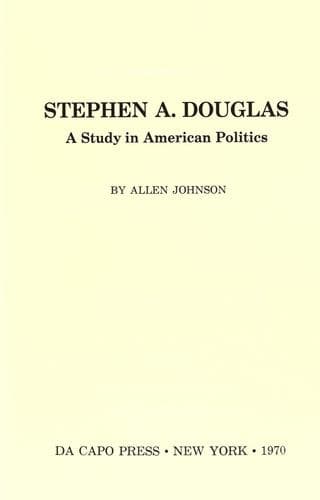
Stephen A. Douglas: A Study in American PoliticsJohnson, Allen
History
Stephen A. Douglas: A Study in American Politics
Johnson, Allen
Douglas, Stephen A. (Stephen Arnold), 1813-1861
The settlement of the West had followed parallels of latitude. The men
of the Lake Plains were transplanted New Englanders, New Yorkers,
Pennsylvanians; the men of the Gulf Plains came from south of Mason
and Dixon's line,--pioneers both, aggressive, bold in initiative, but
alienated by circumstances of tremendous economic significance. If
ever North should be arrayed against South, the makeweight in the
balance would be these pioneers of the Northwest and Southwest. It was
no mean conception to plan for the "man of commerce" who would cross
from one region to the other, with his "assorted cargo,"[344] for in
that cargo were the destinies of two sections and his greatest
commerce was to consist in the exchange of imponderable ideas. The
ideal which inspired Douglas never found nobler expression, than in
these words with which he replied to Webster's slighting reference to
the West:
"There is a power in this nation greater than either the North or the
South--a growing, increasing, swelling power, that will be able to
speak the law to this nation, and to execute the law as spoken. That
power is the country known as the great West--the Valley of the
Mississippi, one and indivisible from the gulf to the great lakes, and
stretching, on the one side and the other, to the extreme sources of
the Ohio and Missouri--from the Alleghanies to the Rocky mountains.
There, Sir, is the hope of this nation--the resting place of the power
that is not only to control, but to save, the Union. We furnish the
water that makes the Mississippi, and we intend to follow, navigate,
and use it until it loses itself in the briny ocean. So with the St.
Lawrence. We intend to keep open and enjoy both of these great outlets
to the ocean, and all between them we intend to take under our
especial protection, and keep and preserve as one free, happy, and
united people. This is the mission of the great Mississippi Valley,
the heart and soul of the nation and the continent."[345]
Meantime Congress was endeavoring to avert the clash of sections by
other measures of accommodation. The veteran Clay, in his favorite
role of peacemaker, had drafted a series of resolutions as a sort of
legislative programme; and with his old-time vigor, was pleading for
mutual forbearance. All wounds might be healed, he believed, by
admitting California with her free constitution; by organizing
territorial governments without any restriction as to slavery, in the
region acquired from Mexico; by settling the Texas boundary and the
Texas debt on a fair basis; by prohibiting the slave trade, but not
slavery, in the District of Columbia; and by providing more carefully
for the rendition of fugitive slaves. Clay, Calhoun, and Webster had
spoken with all the weight of their years upon these propositions,
before Douglas was free to address the Senate.
Public-domain text, read in full here on John Shaqi.
Reviews
Reviews
No reviews yet
Be the first to share your thoughts on this work.
Elsewhere in the archive
Join the Discussion
Join the discussion
Sign in to leave a comment or review.
Sign InorCreate an account