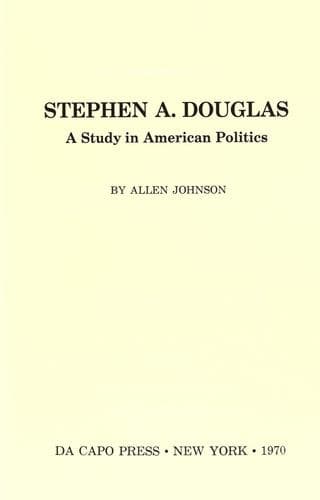
Stephen A. Douglas: A Study in American PoliticsJohnson, Allen
History
Stephen A. Douglas: A Study in American Politics
Johnson, Allen
Douglas, Stephen A. (Stephen Arnold), 1813-1861
Prospective candidates who sat in Congress had at least this
advantage, over their outside competitors,--they could keep themselves
in the public eye by making themselves conspicuous in debate. But the
wisdom of such devices was questionable. Those who could not point
with confident pride to their record, wisely chose to remain
non-committal on matters of personal history. Douglas was one of those
who courted publicity. Perhaps as a young man pitted against older
rivals, he felt that he had everything to gain thereby and not much to
lose. The irrepressible Foote of Mississippi gave all his colleagues a
chance to mar their reputations, by injecting into the deliberations
of the Senate a discussion of the finality of the compromise
measures.[377] It speedily appeared that fidelity to the settlement of
1850, from the Southern point of view, consisted in strict adherence
to the Fugitive Slave Act.[378] This was the touchstone by which
Southern statesmen proposed to test their Northern colleagues.
Prudence whispered silence into many an ear; but Douglas for one
refused to heed her admonitions. Within three weeks after the session
began, he was on his feet defending the consistency of his course,
with an apparent ingenuousness which carried conviction to the larger
audience who read, but did not hear, his declaration of political
faith.
Two features of this speech commended it to Democrats: its
recognition of the finality of the compromise, and its insistence upon
the necessity of banishing the slavery question from politics. "The
Democratic party," he asseverated, "is as good a Union party as I
want, and I wish to preserve its principles and its organization, and
to triumph upon its old issues. I desire no new tests--no
interpolations into the old creed."[379] For his part, he was resolved
never to speak again upon the slavery question in the halls of
Congress.
But this was after all a negative programme. Could a campaign be
successfully fought without other weapons than the well-worn
blunderbusses in the Democratic arsenal? This was a do-nothing policy,
difficult to reconcile with the enthusiastic liberalism which Young
America was supposed to cherish. Yet Douglas gauged the situation
accurately. The bulk of the party wished a return to power more than
anything else. To this end, they were willing to toot for old issues
and preserve the old party alignment. For four years, the Democratic
office-hunters had not tasted of the loaves and fishes within the gift
of the executive. They expected liberality in conduct, if not
liberalism in creed, from their next President. Douglas shared this
political hunger. He had always been a believer in rotation in office,
and an exponent of that unhappy, American practice of using public
office as the spoil of party victory. In this very session, he put
himself on record against permanence in office for the clerks of the
Senate, holding that such positions should fall vacant at stated
intervals.[380]
Public-domain text, read in full here on John Shaqi.
Reviews
Reviews
No reviews yet
Be the first to share your thoughts on this work.
Elsewhere in the archive
Join the Discussion
Join the discussion
Sign in to leave a comment or review.
Sign InorCreate an account