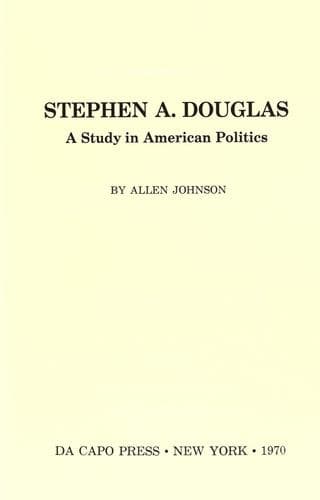
Stephen A. Douglas: A Study in American PoliticsJohnson, Allen
History
Stephen A. Douglas: A Study in American Politics
Johnson, Allen
Douglas, Stephen A. (Stephen Arnold), 1813-1861
It was at this moment in the canvass that the promoters of Douglas's
candidacy made a false move. Taking advantage of the popular
demonstration over Kossuth and the momentary diversion of public
attention from the slavery question to foreign politics, they sought to
thrust Douglas upon the Democratic party as the exponent of a
progressive foreign policy. They presumed to speak in behalf of "Young
America," as against "Old Fogyism." Seizing upon the _Democratic
Review_ as their organ, these progressives launched their boom by a
sensational article in the January number, entitled "Eighteen-Fifty-Two
and the Presidency." Beginning with an arraignment of "Webster's
un-American foreign policy, the writer,--or writers,--called upon
honest men to put an end to this "Quaker policy." "The time has come
for strong, sturdy, clear-headed and honest men to act; and the
Republic must have them, should it be compelled, as the colonies were
in 1776, to drag the hero of the time out of a hole in a wild forest,
[_sic_] whether in Virginia or the illimitable West." To inaugurate
such an era, the presidential chair must be filled by a man, not of the
last generation, but of this. He must not be "trammeled with ideas
belonging to an anterior era, or a man of merely local fame and local
affections, but a statesman who can bring young blood, young ideas, and
young hearts to the councils of the Republic. He must not be a mere
general, a mere lawyer, a mere wire-puller. "Your beaten horse, whether
he ran for a previous presidential cup as first or second," will not
do. He must be 'a tried civilian, not a second and third rate general.'
"Withal, a practical statesman, not to be discomfited in argument, or
led wild by theory, but one who has already, in the councils and
tribunals of the nation, reared his front to the dismay of the shallow
conservative, to the exposure of the humanitarian incendiary, and the
discomfiture of the antiquated rhetorician."
If anyone was so dense as not to recognize the portrait here painted,
he had only to turn to an article entitled "Intervention," to find the
name of the hero who was to usher in the new era. The author of this
paper finds his sentiments so nearly identical with those of Stephen
A. Douglas, that he resorts to copious extracts from his speech
delivered in the Senate on the welcome of Kossuth, "entertaining no
doubt that the American people, the _democracy_ of the country will
endorse these doctrines by an overwhelming majority." Still another
article in this formidable broadside from the editors of the
_Democratic Review_, deprecated Foote's efforts to thrust the slavery
issue again upon Congress, and expressed the pious wish that Southern
delegates might join with Northern in the Baltimore convention, to
nominate a candidate who would in future "evince the most profound
ignorance as to the topographical bearing of that line of discord
known as 'Mason and Dixon's.'"
Public-domain text, read in full here on John Shaqi.
Reviews
Reviews
No reviews yet
Be the first to share your thoughts on this work.
Elsewhere in the archive
Join the Discussion
Join the discussion
Sign in to leave a comment or review.
Sign InorCreate an account