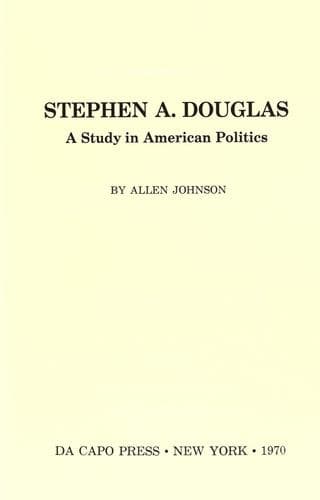
Stephen A. Douglas: A Study in American PoliticsJohnson, Allen
History
Stephen A. Douglas: A Study in American Politics
Johnson, Allen
Douglas, Stephen A. (Stephen Arnold), 1813-1861
It was generally known that Douglas had opposed the Clayton-Bulwer
treaty;[401] but the particular ground of his opposition had been only
surmised. Deeming the injunction of secrecy removed, he now
emphatically registered his protest against the whole policy of
pledging the faith of the Republic, not to do what in the future our
interests, duty, and even safety, might compel us to do. The time
might come when the United States would wish to possess some portion
of Central America. Moreover, the agreement not to fortify any part of
that region was not reciprocal, so long as Great Britain held Jamaica
and commanded the entrance to the canal. He had always regarded the
terms of the British protectorate over the Mosquito coast as
equivocal; but the insuperable objection to the treaty was the
European partnership to which the United States was pledged. The two
parties not only contracted to extend their protection to any other
practicable communications across the isthmus, whether by canal or
railway, but invited all other powers to become parties to these
provisions. What was the purport of this agreement, if it did not
recognize the right of European powers to intervene in American
affairs; what then became of the vaunted Monroe Doctrine?
To the undiplomatic mind of Douglas, our proper course was as clear as
day. Insist upon the withdrawal of Great Britain from the Bay Islands!
"If we act with becoming discretion and firmness, I have no
apprehension that the enforcement of our rights will lead to
hostilities." And then let the United States free itself from
entangling alliances by annulling the Clayton-Bulwer treaty.[402]
Surely this was simplicity itself.
The return of Clayton to the Senate, in the special session of March,
brought the accused before his accusers. An acrimonious debate
followed, in the course of which Douglas was forced to state his own
position more explicitly. He took his stand upon the Hise treaty. Had
the exclusive control of the canal been given into our hands, and the
canal thrown open to the commerce of all nations upon our own terms,
we would have had a right which would have been ample security for
every nation under heaven to keep peace with the United States. "We
could have fortified that canal at each end, and in time of war could
have closed it against our enemies." But, suggested Clayton, European
powers would never have consented to such exclusive control. "Well,
Sir," said Douglas, "I do not know that they would have consented: but
of one thing I am certain I would never have asked their
consent."[403] And such was the temper of Young America that this
sledge hammer diplomacy was heartily admired.
Public-domain text, read in full here on John Shaqi.
Reviews
Reviews
No reviews yet
Be the first to share your thoughts on this work.
Elsewhere in the archive
Join the Discussion
Join the discussion
Sign in to leave a comment or review.
Sign InorCreate an account