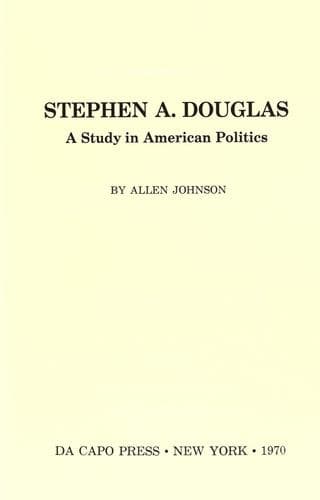
Stephen A. Douglas: A Study in American PoliticsJohnson, Allen
History
Stephen A. Douglas: A Study in American Politics
Johnson, Allen
Douglas, Stephen A. (Stephen Arnold), 1813-1861
At St. Petersburg, his objections to court dress were more
sympathetically received. Count Nesselrode, who found this
uncompromising American possessed of redeeming qualities, put himself
to no little trouble to arrange an interview with the Czar. Douglas
was finally put under the escort of Baron Stoeckle, who was a member
of the Russian embassy at Washington, and conducted to the field where
the Czar was reviewing the army. Mounted upon a charger of huge
dimensions, the diminutive Douglas was brought into the presence of
the Czar of all the Russias.[410] It is said that Douglas was the only
American who witnessed these manoeuvres; but Douglas afterward
confessed, with a laugh at his own expense, that the most conspicuous
feature of the occasion for him was the ominous evolutions of his
horse's ears, for he was too short of limb and too inexperienced a
horseman to derive any satisfaction from the military pageant.[411]
We are assured by his devoted biographer, Sheahan, that Douglas
personally examined _all_ the public institutions of the capital
during his two weeks' stay in St. Petersburg; and that he sought a
thorough knowledge of the manners, laws, and government of that city
and the Empire.[412] No doubt, with his nimble perception he saw much
in this brief sojourn, for Russia had always interested him greatly,
and he had read its history with more than wonted care.[413] He was
not content to follow merely the beaten track in central and western
Europe; but he visited also the Southeast where rumors of war were
abroad. From St. Petersburg, he passed by carriage through the
interior to the Crimea and to Sebastopol, soon to be the storm centre
of war. In the marts of Syria and Asia Minor, he witnessed the contact
of Orient and Occident. In the Balkan peninsula he caught fugitive
glimpses of the rule of the unspeakable Turk.[414]
No man with the quick apperceptive powers of Douglas could remain
wholly untouched by the sights and sounds that crowd upon even the
careless traveler in the East; yet such experiences are not formative
in the character of a man of forty. Douglas was still Douglas, still
American, still Western to the core, when he set foot on native soil
in late October. He was not a larger man either morally or
intellectually; but he had acquired a fund of information which made
him a readier, and possibly a wiser, man. And then, too, he was
refreshed in body and mind. More than ever he was bold, alert,
persistent, and resourceful. In his compact, massive frame, were
stored indomitable pluck and energy; and in his heart the spirit of
ambition stirred mightily.
* * * * *
FOOTNOTES:
[Footnote 370: The speech is given in part by Sheahan, Douglas, pp.
171 ff; and at greater length by Flint, Douglas, App., pp. 3 ff.]
[Footnote 371: Sheahan, Douglas, p. 186; Flint, Douglas, App., p. 30.]
[Footnote 372: _Globe,_31 Cong., 2 Sess., Debate of February 21 and
22, 1851.]
Public-domain text, read in full here on John Shaqi.
Reviews
Reviews
No reviews yet
Be the first to share your thoughts on this work.
Elsewhere in the archive
Join the Discussion
Join the discussion
Sign in to leave a comment or review.
Sign InorCreate an account