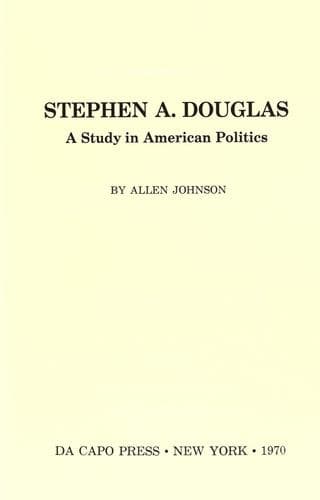
Stephen A. Douglas: A Study in American PoliticsJohnson, Allen
History
Stephen A. Douglas: A Study in American Politics
Johnson, Allen
Douglas, Stephen A. (Stephen Arnold), 1813-1861
Some weeks later, Douglas himself presented another protest, signed by
over five hundred clergymen of the Northwest and accompanied by
resolutions which denounced the Senator from Illinois for his "want of
courtesy and reverence toward man and God."[498] His comments upon
this protest were not calculated to restore him to favor among these
"divinely appointed ministers for the declaration and enforcement of
God's will." His public letter to them, however, was much more
creditable, for in it he avoided abusive language and appealed frankly
to the sober sense of the clergy.[499] Of the repeal of the Missouri
Compromise, he said again that it was necessary, "in order to
recognize the great principle of self-government and State equality.
It does not vary the question in any degree, that human slavery, in
your opinion, is a great moral wrong. If so, it is not the only wrong
upon which the people of each of the States and Territories of this
Union are called upon to act.... You think you are abundantly
competent to decide this question now and forever. If you should
remove to Nebraska, with a view of making it your permanent home,
would you be any less competent to decide it when you should have
arrived in the country?"[500]
The obloquy which Douglas encountered in Washington was mere child's
play, as compared with the storm of abuse that met him on his return
to Chicago. He afterwards said that he could travel from Boston to
Chicago by the light of his own effigies.[501] "Traitor,"
"Arnold,"--with a suggestion that he had the blood of Benedict Arnold
in his veins,--"Judas," were epithets hurled at him from desk and
pulpit. He was presented with thirty pieces of silver by some
indignant females in an Ohio village.[502] So incensed were the people
of Chicago, that his friends advised him not to return, fearing that
he would be assaulted.[503] But fear was a sensation that he had never
experienced. He went to Chicago confident that he could silence
opposition as he had done four years before.[504]
Public-domain text, read in full here on John Shaqi.
Reviews
Reviews
No reviews yet
Be the first to share your thoughts on this work.
Elsewhere in the archive
Join the Discussion
Join the discussion
Sign in to leave a comment or review.
Sign InorCreate an account