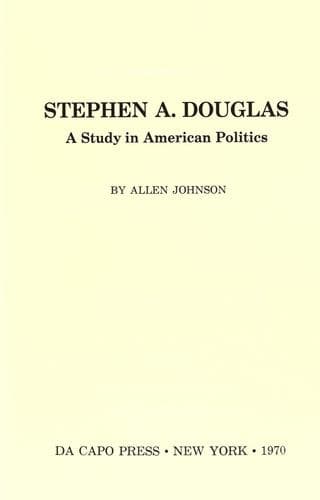
Stephen A. Douglas: A Study in American PoliticsJohnson, Allen
History
Stephen A. Douglas: A Study in American Politics
Johnson, Allen
Douglas, Stephen A. (Stephen Arnold), 1813-1861
In the Sixth Congressional District, Douglas found his friend Harris
fighting desperately with his back against the wall. His opponent,
Yates, was a candidate for re-election, with the full support of
anti-Nebraska men like Trumbull and Lincoln, whom the passage of the
Kansas-Nebraska bill had again drawn into politics. While the State
Fair was in progress at Springfield, both candidates strained every
nerve to win votes. Douglas was summoned to address the goodly body of
Democratic yeomen, who were keenly alive to the political, as well as
to the bucolic, opportunities which the capital afforded at this
interesting season. Douglas spoke to a large gathering in the State
House on October 3d. Next day the Fusionists put forward Lincoln to
answer him; and when Lincoln had spoken for nearly four hours, Douglas
again took the stand and held his audience for an hour and a half
longer.[514] Those were days when the staying powers of speakers were
equalled only by the patience of their hearers.
Like those earlier encounters, whose details have passed into the haze
of tradition, this lacks a trustworthy chronicler. It would seem,
however, as though the dash and daring of Douglas failed to bear down
the cool, persistent opposition of his antagonist. Douglas should have
known that the hazards in his course were reared by his own hand.
Whatever other barriers blocked his way, Nebraska-ism was the most
formidable; but this he would not concede.
A curious story has connected itself with this chance encounter of the
rivals. Alarmed at the effectiveness of Lincoln's attack, so runs the
legend, Douglas begged him not to enter the campaign, promising that
he likewise would be silent thereafter. Aside from the palpable
improbability of this "Peoria truce," it should be noted that Lincoln
accepted an invitation to speak at Lacon next day, without so much as
referring to this agreement, while Douglas continued his campaign with
unremitting energy.[515] If Douglas exhibited fear of an adversary at
this time, it is the only instance in his career.
Public-domain text, read in full here on John Shaqi.
Reviews
Reviews
No reviews yet
Be the first to share your thoughts on this work.
Elsewhere in the archive
Join the Discussion
Join the discussion
Sign in to leave a comment or review.
Sign InorCreate an account