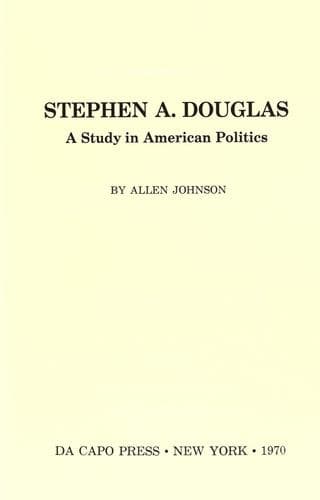
Stephen A. Douglas: A Study in American PoliticsJohnson, Allen
History
Stephen A. Douglas: A Study in American Politics
Johnson, Allen
Douglas, Stephen A. (Stephen Arnold), 1813-1861
When to desertion was added association with "Black Republicans,"
Douglas found his vocabulary inadequate to express his scorn. Like
most Democrats he was sensitive on the subject of party
nomenclature.[525] "Republican" was a term which had associations with
the very father of Democracy, though the party had long since dropped
the hyphenated title. But this new, so-called Republican party had
wisely dropped the prefix "national," suggested Douglas, because "it
is a purely sectional party, with a platform which cannot cross the
Ohio river, and a creed which inevitably brings the North and South
into hostile collision." In view of the emphasis which their platform
put upon the negro, Douglas thought that consistency required the
substitution of the word "Black" for "National." The Democratic party,
on the other hand, had no sympathy with those who believed in making
the negro the social and political equal of the white man. "Our people
are a white people; our State is a white State; and we mean to
preserve the race pure, without any mixture with the negro. If you,"
turning to his Republican opponents, "wish your blood and that of the
African mingled in the same channel, we trust that you will keep at a
respectful distance from us, and not try to force that on us as one of
your domestic institutions."[526] In such wise, Douglas labored to
befog and discredit the issues for which the new party stood. The
demagogue in him overmastered the statesman.
Douglas believed himself--and with good reason--to be the probable
nominee of his party in the approaching presidential election. Several
State conventions had already declared for him. There was no other
Democrat, save President Pierce, whose name was so intimately
associated with the policy of the party as expressed in the
Kansas-Nebraska bill. Yet, while both were in favor at the South,
neither Pierce nor Douglas was likely to secure the full party vote at
the North. This consideration led to a diversion in favor of James
Buchanan, of Pennsylvania. The peculiar availability of this
well-known Democrat consisted in his having been on a foreign mission
when the Kansas-Nebraska bill was under fire. Still, Buchanan was
reported "sound" on the essential features of this measure. Before the
national convention met, a well-organized movement was under way to
secure the nomination of the Pennsylvanian.[527] Equally
well-organized and even more noisy and demonstrative was the following
of Douglas, as the delegates began to assemble at Cincinnati during
the first week in June.
Public-domain text, read in full here on John Shaqi.
Reviews
Reviews
No reviews yet
Be the first to share your thoughts on this work.
Elsewhere in the archive
Join the Discussion
Join the discussion
Sign in to leave a comment or review.
Sign InorCreate an account