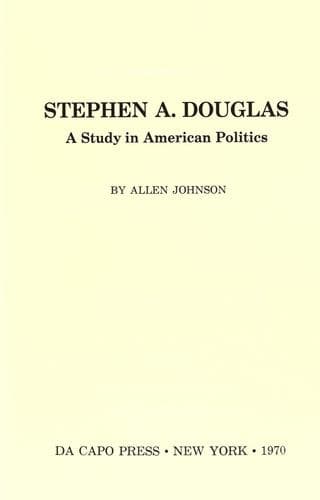
Stephen A. Douglas: A Study in American PoliticsJohnson, Allen
History
Stephen A. Douglas: A Study in American Politics
Johnson, Allen
Douglas, Stephen A. (Stephen Arnold), 1813-1861
Far different was the election of members of the territorial
legislature in the following spring. On all hands it was agreed that
this legislature would determine whether Kansas should be slave or
free soil. It was regrettable that Governor Reeder postponed the
taking of the census until February, since by mid-winter many
settlers, who had staked their claims, returned home for the cold
season, intending to return with their families in the early spring.
This again was a characteristic feature of frontier history.[537] In
March, the governor issued his proclamation of election, giving only
three weeks' notice. Of those who had returned home, only residents of
Missouri and Iowa were able to participate in the election of March
30th, by hastily recrossing into Kansas. Governor Reeder did his best
to guard against fraud. In his instructions to the judges of election,
he warned them that a voter must be "an actual resident"; that is,
"must have commenced an active inhabitancy, which he actually intends
to continue permanently, and must have made the Territory his dwelling
place to the exclusion of any other home."[538] Still, it was not to
be expected that _bona fide_ residents could be easily ascertained in
communities which had sprung up like mushrooms. A hastily constructed
shack served all the purposes of the would-be voter; and, in last
analysis, judges of elections had to rest content with declarations of
intentions. Those who crossed into Kansas after the governor's
proclamation and endeavored to continue actual inhabitancy, were with
difficulty distinguished from those who now crossed for the first
time, under a similar pretext. As Douglas subsequently contended with
much force, the number of votes cast in excess of the census returns
did not in itself prove wholesale fraud.[539]
Under such liability to deception and misjudgment, the territorial
authorities held the election which was likely to determine the status
of Kansas with respect to slavery. Both parties were playing for great
stakes; passion and violence were the almost inevitable outcome. Both
parties contained desperadoes, who invariably come to the surface in
the general mixing which occurs on the frontier. Both parties committed
frauds at the polls. But the most serious gravamina have been laid at
the door of those Blue Lodges of Missouri which deliberately sought to
secure the election of pro-slavery candidates by fair means or foul.
The people of western Missouri had come to believe that the fate of
slavery in their own Commonwealth hinged upon the future of Kansas. It
was commonly believed that after Kansas, Missouri would be
abolitionized. It was, therefore, with the fierce, unreasoning energy
of defenders of their own institutions, that Blue Lodges organized
their crusade for Kansas.[540] On election day armed bands of
Missourians crossed into Kansas and polled a heavy vote for the
pro-slavery candidates, in the teeth of indignant remonstrances.[541]
Public-domain text, read in full here on John Shaqi.
Reviews
Reviews
No reviews yet
Be the first to share your thoughts on this work.
Elsewhere in the archive
Join the Discussion
Join the discussion
Sign in to leave a comment or review.
Sign InorCreate an account