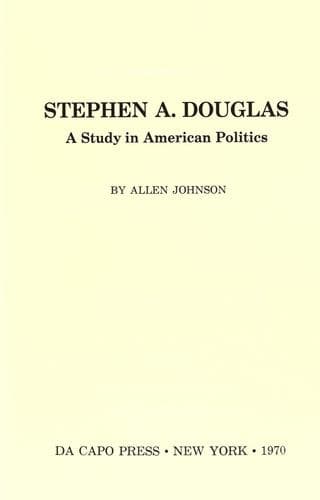
Stephen A. Douglas: A Study in American PoliticsJohnson, Allen
History
Stephen A. Douglas: A Study in American Politics
Johnson, Allen
Douglas, Stephen A. (Stephen Arnold), 1813-1861
Even hostile critics were forced to yield to a certain admiration for
"the Little Giant." The author of _Uncle Tom's Cabin_ watched him from
her seat in the Senate gallery, with intense interest; and though
writing for readers, who like herself hated the man for his supposed
servility to the South, she said with unwonted objectivity, "This
Douglas is the very ideal of vitality. Short, broad, and thick-set,
every inch of him has its own alertness and motion. He has a good head
and face, thick black hair, heavy black brows and a keen eye. His
figure would be an unfortunate one were it not for the animation which
constantly pervades it; as it is, it rather gives poignancy to his
peculiar appearance; he has a small, handsome hand, moreover, and a
graceful as well as forcible mode of using it.... He has two
requisites of a debater--a melodious voice and a clear, sharply
defined enunciation.... His forte in debating is his power of
mystifying the point. With the most off-hand assured airs in the
world, and a certain appearance of honest superiority, like one who
has a regard for you and wishes to set you right on one or two little
matters, he proceeds to set up some point which is _not_ that in
question, but only a family connection of it, and this point he
attacks with the very best of logic and language; he charges upon it
horse and foot, runs it down, tramples it in the dust, and then turns
upon you with--'Sir, there is your argument! Did not I tell you so?
You see it is all stuff;' and if you have allowed yourself to be so
dazzled by his quickness as to forget that the routed point is not,
after all, the one in question, you suppose all is over with it.
Moreover, he contrives to mingle up so many stinging allusions to so
many piquant personalities that by the time he has done his
mystification a dozen others are ready and burning to spring on their
feet to repel some direct or indirect attack, all equally wide of the
point."[562]
Douglas paid dearly for some of these personal shots. He had never
forgiven Sumner for his share in "the Appeal of the Independent
Democrats." He lost no opportunity to attribute unworthy motives to
this man, whose radical views on slavery he never could comprehend.
More than once he insinuated that the Senator from Massachusetts and
other Black Republicans were fabricating testimony relating to Kansas
for political purposes. When Sumner, many weeks later, rose to address
the Senate on "the Crime against Kansas," he labored under the double
weight of personal wrongs and the wrongs of a people. The veteran Cass
pronounced his speech "the most un-American and unpatriotic that ever
grated on the ears of the members of this high body."[563] Even
Sumner's friends listened to him with surprise and regret. Of Douglas
he had this to say:
Public-domain text, read in full here on John Shaqi.
Reviews
Reviews
No reviews yet
Be the first to share your thoughts on this work.
Elsewhere in the archive
Join the Discussion
Join the discussion
Sign in to leave a comment or review.
Sign InorCreate an account