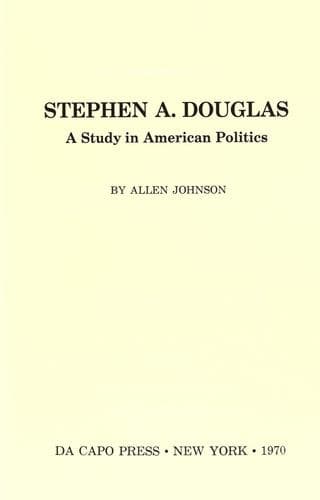
Stephen A. Douglas: A Study in American PoliticsJohnson, Allen
History
Stephen A. Douglas: A Study in American Politics
Johnson, Allen
Douglas, Stephen A. (Stephen Arnold), 1813-1861
It was afterwards alleged that Douglas had wittingly suppressed a
clause in the original Toombs bill, which provided for a submission of
the constitution to a popular vote. The circumstances were such as to
make the charge plausible, and Douglas, in his endeavor to clear
himself, made hasty and unqualified statements which were manifestly
incorrect. In his own bill for the admission of Kansas, Douglas
referred explicitly to "the election for the adoption of the
Constitution."[577] The wording of the clause indicates that he
regarded the popular ratification of the constitution to be a matter
of course. The original Toombs bill had also referred explicitly to a
ratification of the constitution by the people;[578] but when it was
reported from Douglas's committee in an amended form, it had been
stripped of this provision. Trumbull noted at the time that this
amended bill made no provision for the submission of the constitution
to the vote of the people and deplored the omission, though he
supposed, as did most men, that such a ratification would be
necessary.[579] Subsequently he accused Douglas not only of having
intentionally omitted the referendum clause, but of having prevented a
popular vote, by adding the clause, "and until the complete execution
of this Act, no other election shall be held in said Territory."[580]
Douglas cleared himself from the latter charge, by pointing out that
this clause had been struck out upon his own motion, and replaced by
the clause which read, "all other elections in said Territory are
hereby postponed until such time as said convention shall
appoint."[581] As to the other charge, Douglas said in 1857, that he
knew the Toombs bill was silent on the matter of submission, but he
took the fair construction to be that powers not delegated were
reserved, and that of course the constitution would be submitted to
the people. "That I was a party, either by private conferences at my
house or otherwise, to a plan to force a constitution on the people of
Kansas without submission, is not true."[582]
Still, there was the ugly fact that the Toombs bill had gone to his
committee with the clause, and had emerged shorn of it. Toombs himself
threw some light on the matter by stating that the clause had been
stricken out because there was no provision for a second election, and
therefore no proper safeguards for such a popular vote.[583] The
probability is that Douglas, and in fact most men, deemed it
sufficient at that time to provide a fair opportunity for the
election of a convention.[584] When Trumbull preferred his charges in
detail in the campaign of 1858, Douglas at first flatly denied that
there was a submission clause in the original Toombs bill. Both
Trumbull and Lincoln then convicted Douglas of error, and thus put him
in the light of one who had committed an offense and had sought to
save himself by prevaricating.
Public-domain text, read in full here on John Shaqi.
Reviews
Reviews
No reviews yet
Be the first to share your thoughts on this work.
Elsewhere in the archive
Join the Discussion
Join the discussion
Sign in to leave a comment or review.
Sign InorCreate an account