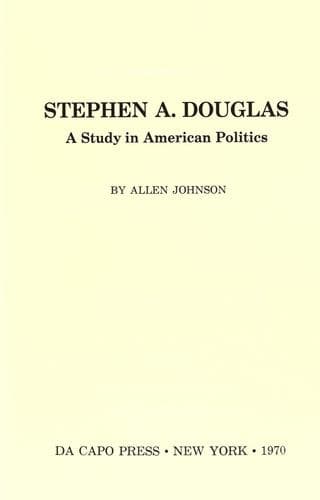
Stephen A. Douglas: A Study in American PoliticsJohnson, Allen
History
Stephen A. Douglas: A Study in American Politics
Johnson, Allen
Douglas, Stephen A. (Stephen Arnold), 1813-1861
Events in Kansas gave heart to those who were fighting Lecomptonism.
At the election appointed by the convention, the "constitution with
slavery" was adopted by a large majority, the free-State people
refusing to vote; but the legislature, now in the control of the
free-State party, had already provided for a fair vote on the whole
constitution. On this second vote the majority was overwhelmingly
against the constitution. Information from various sources
corroborated the deductions which unprejudiced observers drew from the
voting. It was as clear as day that the people of Kansas did not
regard the Lecompton constitution as a fair expression of their
will.[649]
Ignoring the light which made the path of duty plain, President
Buchanan sent the Lecompton constitution to Congress with a message
recommending the admission of Kansas.[650] To his mind, the Lecompton
convention was legally constituted and had exercised its powers
faithfully. The organic act did not bind the convention to submit to
the people more than the question of slavery. Meantime the Supreme
Court had handed down its famous decision in the Dred Scott case.
Fortified by this dictum, the President told Congress that slavery
existed in Kansas by virtue of the Constitution of the United States.
"Kansas is, at this moment, as much a slave State as Georgia or South
Carolina"! Slavery, then, could be prohibited only by constitutional
provision; and those who desired to do away with slavery would most
speedily compass their ends, if they admitted Kansas at once under
this constitution.
The President's message with the Lecompton constitution was referred
to the Committee on Territories and gave rise to three reports:
Senator Green of Missouri presented the majority report, recommending
the admission of Kansas under this constitution; Senators Collamer and
Wade united on a minority report, leaving Douglas to draft another
expressing his dissent on other grounds.[651] Taken all in all, this
must be regarded as the most satisfactory and convincing of all
Douglas's committee reports. It is strong because it is permeated by
a desire for justice, and reinforced at every point by a consummate
marshalling of evidence. Barely in his career had his conspicuous
qualities as a special pleader been put so unreservedly at the service
of simple justice. He planted himself firmly, at the outset, upon the
incontrovertible fact that there was no satisfactory evidence that the
Lecompton constitution was the act and deed of the people of
Kansas.[652]
Public-domain text, read in full here on John Shaqi.
Reviews
Reviews
No reviews yet
Be the first to share your thoughts on this work.
Elsewhere in the archive
Join the Discussion
Join the discussion
Sign in to leave a comment or review.
Sign InorCreate an account