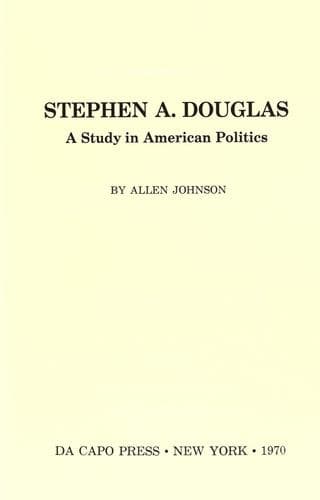
Stephen A. Douglas: A Study in American PoliticsJohnson, Allen
History
Stephen A. Douglas: A Study in American Politics
Johnson, Allen
Douglas, Stephen A. (Stephen Arnold), 1813-1861
The opposition of Douglas began to cause no little uneasiness. Brown
paid tribute to his influence, when he declared that if the Senator
from Illinois had stood with the administration, "there would not have
been a ripple on the surface." "Sir, the Senator from Illinois gives
life, he gives vitality, he gives energy, he lends the aid of his
mighty genius and his powerful will to the Opposition on this
question."[655] But Douglas paid a fearful price for this power. Every
possible ounce of pressure was brought to bear upon him. The party
press was set upon him. His friends were turned out of office. The
whole executive patronage was wielded mercilessly against his
political following. The Washington _Union_ held him up to execration
as a traitor, renegade, and deserter.[656] "We cannot affect
indifference at the treachery of Senator Douglas," said a Richmond
paper. "He was a politician of considerable promise. Association with
Southern gentlemen had smoothed down the rugged vulgarities of his
early education, and he had come to be quite a decent and well-behaved
person."[657] To political denunciation was now to be added the sting
of mean and contemptible personalities.
Small wonder that even the vigorous health of "the Little Giant"
succumbed to these assaults. For a fortnight he was confined to his
bed, rising only by sheer force of will to make a final plea for
sanity, before his party took its suicidal plunge. He spoke on the 22d
of March under exceptional conditions. In the expectation that he
would speak in the forenoon, people thronged the galleries at an
early hour, and refused to give up their seats, even when it was
announced that the Senator from Illinois would not address the Senate
until seven o 'clock in the evening. When the hour came, crowds still
held possession of the galleries, so that not even standing room was
available. The door-keepers wrestled in vain with an impatient throng
without, until by motion of Senator Gwin, ladies were admitted to the
floor of the chamber. Even then, Douglas was obliged to pause several
times, for the confusion around the doors to subside.[658] He spoke
with manifest difficulty, but he was more defiant than ever. His
speech was at once a protest and a personal vindication. Denial of the
right of the administration to force the Lecompton constitution upon
the people of Kansas, went hand in hand with a defense of his own
Democracy. Sentences culled here and there suggest not unfairly the
stinging rebukes and defiant challenges that accentuated the none too
coherent course of his speech:
Public-domain text, read in full here on John Shaqi.
Reviews
Reviews
No reviews yet
Be the first to share your thoughts on this work.
Elsewhere in the archive
Join the Discussion
Join the discussion
Sign in to leave a comment or review.
Sign InorCreate an account