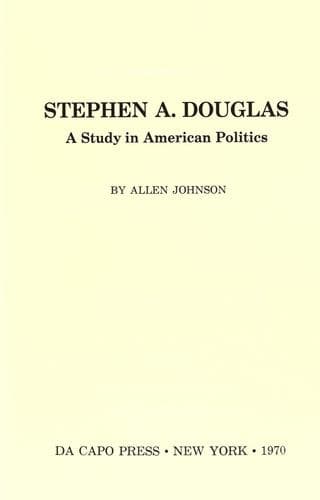
Stephen A. Douglas: A Study in American PoliticsJohnson, Allen
History
Stephen A. Douglas: A Study in American Politics
Johnson, Allen
Douglas, Stephen A. (Stephen Arnold), 1813-1861
Lincoln also betrayed his fear lest Douglas should draw Republican
votes. Knowing the strong anti-slavery sentiment of the region, he
asked when Douglas had shown anything but indifference on the subject
of slavery. Away with this quibbling about inferior races! "Let us
discard all these things and unite as one people throughout this land,
until we shall once more stand up declaring that all men are created
equal."[691]
From Chicago Douglas journeyed like a conquering hero to Bloomington.
At every station crowds gathered to see his gaily decorated train and
to catch a glimpse of the famous senator. A platform car bearing a
twelve-pound gun was attached to the train and everywhere "popular
sovereignty," as the cannon was dubbed, heralded his arrival.[692] On
the evening of July 16th he addressed a large gathering in the open
air; and again he had among his auditors, Abraham Lincoln, who was hot
upon his trail.[693] The county and district in which Bloomington was
situated had once been strongly Whig; but was now as strongly
Republican. With the local conditions in mind, Douglas made an artful
plea for support. He gratefully acknowledged the aid of the
Republicans in the recent anti-Lecompton fight, and of that worthy
successor of the immortal Clay, John J. Crittenden of Kentucky. After
all, was it not a common principle for which they had been contending?
"My friends," said Douglas with engaging ingenuousness, "when I am
battling for a great principle, I want aid and support from whatever
quarter I can get it." Pity, then, that Republican politicians, in
order to defeat him, should form an alliance with Lecompton men and
thus betray the cause![694]
Douglas called attention to Lincoln's explanation of his
house-divided-against-itself argument. It still seemed to him to
invite a war of sections. Mr. Lincoln had said that he had no wish to
see the people _enter into_ the Southern States and interfere with
slavery: for his part, he was equally opposed to a sectional agitation
to control the institutions of other States.[695] Again, Mr. Lincoln
had said that he proposed, so far as in him lay, to secure a reversal
of the Dred Scott decision. How, asked Douglas, will he accomplish
this? There can be but one way: elect a Republican President who will
pack the bench with Republican justices. Would a court so constituted
command respect?[696]
Public-domain text, read in full here on John Shaqi.
Reviews
Reviews
No reviews yet
Be the first to share your thoughts on this work.
Elsewhere in the archive
Join the Discussion
Join the discussion
Sign in to leave a comment or review.
Sign InorCreate an account