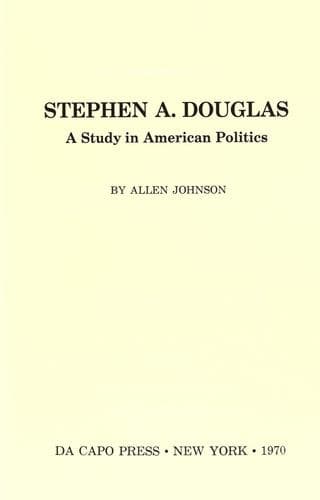
Stephen A. Douglas: A Study in American PoliticsJohnson, Allen
History
Stephen A. Douglas: A Study in American Politics
Johnson, Allen
Douglas, Stephen A. (Stephen Arnold), 1813-1861
It was Lincoln's turn to open the joust. At the outset he tried to
allay misapprehensions regarding his attitude toward negro equality.
"I will say, then, that I am not, nor ever have been, in favor of
bringing about in any way the social and political equality of the
white and black races; that I am not, nor ever have been, in favor of
making voters or jurors of negroes, nor of qualifying them to hold
office, nor to intermarry with white people; and I will say in
addition to this, that there is a physical difference between the
white and black races which I believe will forever forbid the two
races living together on terms of social and political equality. And
inasmuch as they cannot so live, while they do remain together there
must be the position of superior and inferior, and I as much as any
other man am in favor of having the superior position assigned to the
white race. I say upon this occasion I do not perceive that because
the white man is to have the superior position the negro should be
denied everything. I do not understand that because I do not want a
negro woman for a slave I must necessarily want her for a wife. My
understanding is that I can just let her alone."[741] This was by far
the most explicit statement that he had yet made on the hazardous
subject.
Lincoln then turned upon his opponent, with more aggressiveness than,
he had hitherto exhibited, to drive home the charge which Trumbull had
made earlier in the campaign. Prompted by Trumbull, probably, Lincoln
reviewed the shadowy history of the Toombs bill and Douglas's still
more enigmatical connection with it. The substance of the indictment
was, that Douglas had suppressed that part of the original bill which
provided for a popular vote on the constitution to be drafted by the
Kansas convention. In replying to Trumbull, Douglas had damaged his
own case by denying that the Toombs bill had ever contained such a
provision. Lincoln proved the contrary by the most transparent
testimony, convicting Douglas not only of the original offense but of
an untruth in connection with it.[742]
Public-domain text, read in full here on John Shaqi.
Reviews
Reviews
No reviews yet
Be the first to share your thoughts on this work.
Elsewhere in the archive
Join the Discussion
Join the discussion
Sign in to leave a comment or review.
Sign InorCreate an account