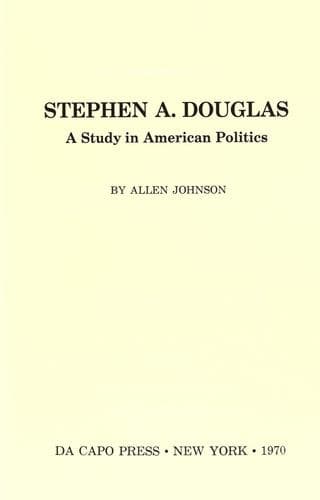
Stephen A. Douglas: A Study in American PoliticsJohnson, Allen
History
Stephen A. Douglas: A Study in American Politics
Johnson, Allen
Douglas, Stephen A. (Stephen Arnold), 1813-1861
On the following day both Lincoln and Douglas took passage on a river
steamer for Alton. The county of Madison had once been Whig in its
political proclivities. In the State legislature it was now
represented by two representatives and a senator who were Native
Americans; and in the present campaign, the county was classed as
doubtful. In Alton and elsewhere there was a large German vote which
was likely to sway the election.
Douglas labored under a physical disadvantage. His voice was painful
to hear, while Lincoln's betrayed no sign of fatigue.[766] Both fell
into the argument _ad hominem_. Lincoln advocated holding the
Territories open to "free white people" the world over--to "Hans,
Baptiste, and Patrick." Douglas contended that the equality referred
to in the Declaration of Independence, was the equality of white
men--"men of European birth and European descent." Both conjured with
the revered name of Clay. Douglas persistently referred to Lincoln as
an Abolitionist, knowing that his auditors had "strong sympathies
southward," as Lincoln shrewdly guessed; while Lincoln sought to
unmask that "false statesmanship that undertakes to build up a system
of policy upon the basis of caring nothing about the very thing that
everybody does care the most about."[767]
Douglas made a successful appeal to the sympathy of the crowd, when he
said of his conduct in the Lecompton fight, "Most of the men who
denounced my course on the Lecompton question objected to it, not
because I was not right, but because they thought it expedient at that
time, for the sake of keeping the party together, to do wrong. I never
knew the Democratic party to violate any one of its principles, out of
policy or expediency, that it did not pay the debt with sorrow. There
is no safety or success for our party unless we always do right, and
trust the consequences to God and the people. I chose not to depart
from principle for the sake of expediency on the Lecompton question,
and I never intend to do it on that or any other question."[768]
Both at Quincy and at Alton, Douglas paid his respects to the
"contemptible crew" who were trying to break up the party and defeat
him. At first he had avoided direct attacks upon the administration;
but the relentless persecution of the Washington _Union_ made him
restive. Lincoln derived great satisfaction from this intestine
warfare in the Democratic camp. "Go it, husband! Go it, bear!" he
cried.
In this last debate, both sought to summarize the issues. Said
Lincoln, "You may turn over everything in the Democratic policy from
beginning to end, ... it everywhere carefully excludes the idea that
there is anything wrong in it [slavery].
Public-domain text, read in full here on John Shaqi.
Reviews
Reviews
No reviews yet
Be the first to share your thoughts on this work.
Elsewhere in the archive
Join the Discussion
Join the discussion
Sign in to leave a comment or review.
Sign InorCreate an account