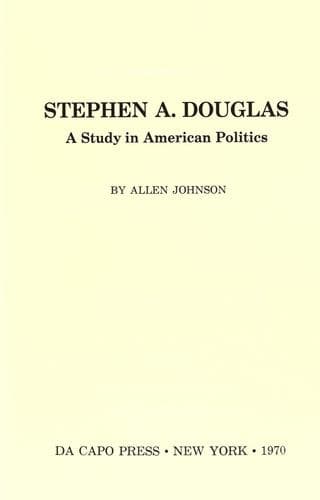
Stephen A. Douglas: A Study in American PoliticsJohnson, Allen
History
Stephen A. Douglas: A Study in American Politics
Johnson, Allen
Douglas, Stephen A. (Stephen Arnold), 1813-1861
As Douglas journeyed southward soon after the November elections, he
must have felt the poignant truth of Lincoln's shrewd observation that
he was himself becoming sectional. Though he was received with seeming
cordiality at Memphis and New Orleans, he could not but notice that
his speeches, as Lincoln predicted, "would not go current south of the
Ohio River as they had formerly." Democratic audiences applauded his
bold insistence upon the universality of the principles of the party
creed, but the tone of the Southern press was distinctly unfriendly
to him and his Freeport doctrine.[776] He told his auditors at Memphis
that he indorsed the decision of the Supreme Court; he believed that
the owners of slaves had the same right to take them into the
Territories as they had to take other property; but slaves once in the
Territory were then subject to local laws for protection, on an equal
footing with all other property. If no local laws protecting slave
property were passed, slavery would be practically excluded.
"Non-action is exclusion." It was a matter of soil, climate,
interests, whether a Territory would permit slavery or not. "You come
right back to the principle of dollars and cents ... If old Joshua E.
Giddings should raise a colony in Ohio and settle down in Louisiana,
he would be the strongest advocate of slavery in the whole South; he
would find when he got there, his opinion would be very much modified;
he would find on those sugar plantations that it was not a question
between the white man and the negro, but between the negro and the
crocodile." "The Almighty has drawn the line on this continent, on one
side of which the soil must be cultivated by slave labor; on the other
by white labor."[777]
At New Orleans, he repeated more emphatically much the same thought.
"There is a line, or belt of country, meandering through the valleys
and over the mountain tops, which is a natural barrier between free
territory and slave territory, on the south of which are to be found
the productions suitable to slave labor, while on the north exists a
country adapted to free labor alone.... But in the great central
regions, where there may be some doubt as to the effect of natural
causes, who ought to decide the question except the people residing
there, who have all their interests there, who have gone there to live
with their wives and children!"[778]
Public-domain text, read in full here on John Shaqi.
Reviews
Reviews
No reviews yet
Be the first to share your thoughts on this work.
Elsewhere in the archive
Join the Discussion
Join the discussion
Sign in to leave a comment or review.
Sign InorCreate an account