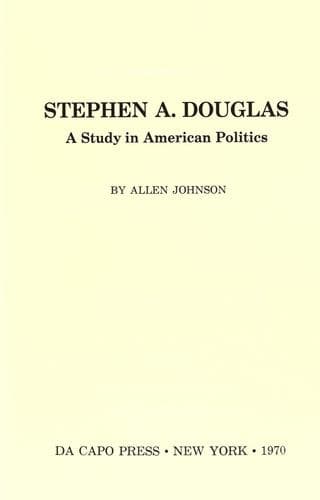
Stephen A. Douglas: A Study in American PoliticsJohnson, Allen
History
Stephen A. Douglas: A Study in American Politics
Johnson, Allen
Douglas, Stephen A. (Stephen Arnold), 1813-1861
After the 23d of February, Douglas neither gave nor expected quarter
from the Southern faction led by Jefferson Davis. So far from avoiding
conflict, he seems rather to have forced the fighting. He flaunted his
views in the faces of the fire-eaters. Prudence would have suggested
silence, when a convention of Southern States met at Vicksburg and
resolved that "all laws, State and Federal, prohibiting the African
slave-trade, ought to be repealed,"[790] but Douglas, who knew
something of the dimensions which this illicit traffic had already
assumed, at once declared himself opposed to it. He said privately in
a conversation, which afterwards was reported by an anonymous
correspondent to the New York _Tribune_, that he believed fifteen
thousand Africans were brought into the country last year. He had seen
"with his own eyes three hundred of those recently imported miserable
beings in a slave-pen at Vicksburg, Mississippi, and also large
numbers at Memphis, Tennessee."[791]
In a letter which speedily became public property, Douglas said that
he would not accept the nomination of the Democratic party, if the
convention should interpolate into the party creed "such new issues as
the revival of the African slave-trade, or a congressional slave code
for the Territories."[792] And to leave no doubt as to his attitude he
wrote a second letter, devoted exclusively to this subject; it also
found its way, as the author probably intended it should, into the
newspapers. He opposed the revival of the African slave-trade because
it was abolished by one of the compromises which had made the Federal
Union and the Constitution. "In accordance with this compromise, I am
irreconcilably opposed to the revival of the African slave-trade, in
any form and under any circumstances."[793] How deeply this
unequivocal condemnation lacerated the feelings of the South, will
never be known until the economic necessities and purposes of the
large plantation owners are more clearly revealed.
Public-domain text, read in full here on John Shaqi.
Reviews
Reviews
No reviews yet
Be the first to share your thoughts on this work.
Elsewhere in the archive
Join the Discussion
Join the discussion
Sign in to leave a comment or review.
Sign InorCreate an account